The question of whether paying a recruiting agency is even worth it comes back around in companies on a regular cycle, especially when budgets are tight and searches are taking longer than they used to. The math looks simple on the surface: an agency takes somewhere between ten and several dozen percent of a candidate’s annual salary, while more and more of the recruiting workflow can now be automated with AI. Does that mean the classic agency model has quietly gone obsolete?
The answer isn’t that clean-cut. On one hand, the market really is shifting: pressure to cut rates is rising, clients have more tools and data at their disposal, and AI is genuinely bringing down agencies’ operating costs. On the other hand, in specialist, managerial, and executive hiring, an agency’s value still comes from something automation can’t replace: access to candidates, the ability to actually assess competence, and negotiation skill.
Below is a current look at the rates, the reasons agency recruiting can feel overpriced, and concrete ways to bring the cost down without giving up the results.
What Agency Recruiting Costs — Current Rates
The Polish market runs mostly on a success-fee model: the client pays only once a candidate is actually hired. The rate depends on seniority, how hard the search is, the industry, and whether the agency is working the role exclusively. Some agencies also use a retainer model (an upfront fee), which raises the bar for even starting the engagement.
| Type of Hire | Typical Fee |
|---|---|
| Specialist roles | 15–20% of annual gross salary |
| Managers | 18–25% of annual gross salary |
| Directors | 20–28% of annual gross salary |
| Executive Search / C-level | 25–35% of annual gross salary (often retained search) |
What the Market Looks Like in Mid-2026
The recruiting market in Poland today could best be described as stable, but noticeably tougher for agencies than it was in 2021–2022. There’s no collapse, but there’s no boom either — clients are hiring more cautiously, searches drag on longer, and price pressure is distinctly sharper.
Roughly 84% of employers plan to hire in 2026, though a good share of that hiring stems from reorganization and business transformation rather than genuine headcount growth.
Competition among agencies is intensifying:
- clients increasingly invite several agencies into the same search at once,
- they expect lower success fees (12–18% instead of 20–25%),
- many companies are building their own in-house Talent Acquisition teams or turning to RPO instead of the classic success-fee model.
Why Agency Recruiting Sometimes Feels Overpriced
From the client’s side, there are several concrete reasons the cost of working with an agency can be hard to justify.
A wide margin relative to the actual cost of delivery. In many success-fee arrangements, what the agency earns significantly outstrips the real labor cost behind the search — especially for simpler or recurring roles. High rates often end up compensating the agency for searches that failed elsewhere.
The rise of AI and automation. Candidate sourcing, profile searches, first-round screening, and candidate outreach are all partially automated today — part of a broader shift in where AI actually helps recruiters, and where it still falls short. If the cost of delivering a search is falling, clients reasonably expect that to show up in the price. With AI tools properly in place, the numbers look like this:
- a 10–20% lower total recruiting cost with basic AI use (ChatGPT, Copilot, automated content drafting),
- a 20–40% lower cost when AI is integrated with the ATS for automated sourcing, screening, and candidate communication,
- a 40–60% cut in the recruiting team’s operating costs at organizations that have rebuilt their processes around AI — this refers mainly to the team’s own labor cost, not the total cost of the hire.
Easier access to candidates. LinkedIn, specialized job boards, employee referrals, and agencies’ own extensive candidate databases all make finding many specialists far simpler than it was a few years ago. In those cases, the added value an agency brings can be fairly limited.
Increasingly capable in-house TA teams. Large companies are investing in recruiting, employer branding, and technology, and they also hold a stronger negotiating position when buying job-board placements — many are actively building out recruitment teams that scale with the company rather than leaning on agencies by default. For them, using an agency often means paying for capabilities they already have.
A success fee that’s detached from actual effort. An agency might collect several tens of thousands of złoty for a search that took two weeks, simply because the candidate was already in their database or applied directly off the job posting. The client is paying for the outcome, not the real effort behind it.
Risk sitting with the client. Even with an agency’s guarantee in place, the client absorbs the cost of onboarding, managers’ time, and lost opportunity if the new hire doesn’t work out.
No exclusivity. When several agencies work the same role in parallel, each one puts in similar effort, but only one of them gets paid. To offset that risk, agencies keep their rates higher across the board — one of several reasons it’s worth thinking carefully about when and why it makes sense to change recruitment agencies rather than running several at once.
Unpredictable costs. Filling a role paying 25,000 zł a month can cost the client 60,000–90,000 zł. Multiply that across several hires, and it becomes a serious budget line.
Not every search actually needs it. For roles with a large, easy-to-reach candidate pool, or for a well-known, attractive employer, paying an agency fee can be hard to justify economically.
Cheaper alternatives exist. More and more companies are turning to freelance recruiters, RPO models, contract recruiters, marketplace platforms, or AI sourcing tools — in many cases delivering a similar result at a lower cost.
Can Working With an Agency Actually Get Cheaper?
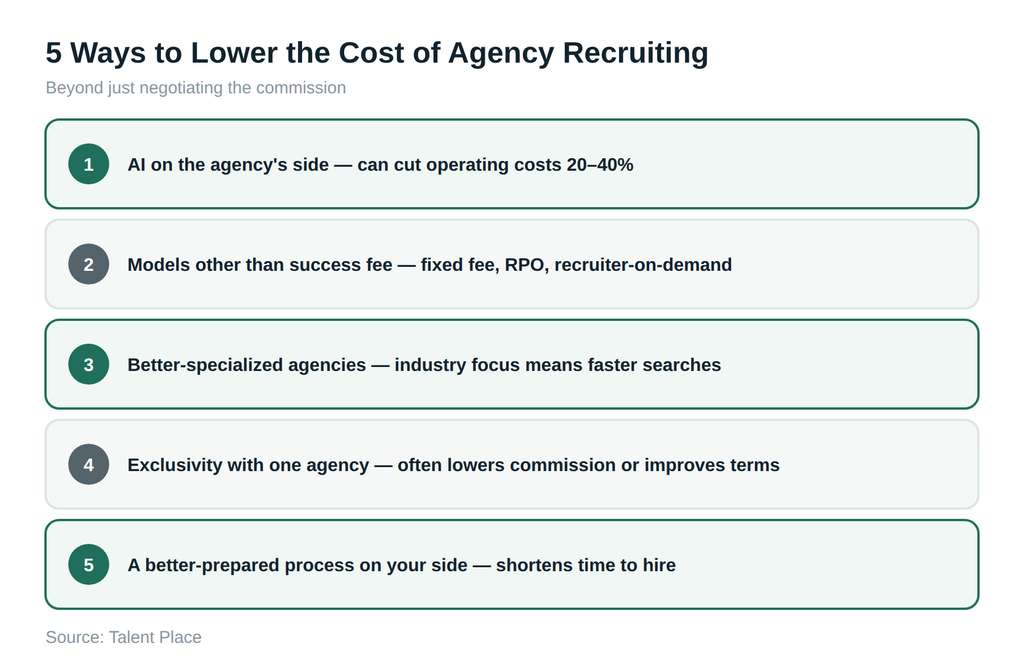
Yes — but not necessarily just by negotiating the commission down. The biggest savings usually come from changing the collaboration model itself and from putting technology to work.
- AI on the agency’s side. Automating sourcing, CV screening, communication, and reporting can cut an agency’s operating costs by 20–40%. If agencies pass some of those savings on to clients, success-fee rates could gradually come down over time.
- Models other than success fee — a fixed project fee, RPO, recruiter-on-demand / embedded recruiter arrangements, or subscription models for companies running multiple searches at once.
- Better-specialized agencies. An agency focused on a single industry typically finds candidates faster, which lowers the cost of the whole process — one of the criteria worth weighing when choosing which recruitment agency to work with.
- Exclusivity with one agency. In exchange for exclusivity, many agencies are willing to lower their commission or offer stronger guarantee terms.
- A better-prepared process on the client’s side. A clear role profile, fast feedback, and quick decision-making shorten the time to hire — which lowers the cost of delivery and can translate into a lower price.
Will Commissions Actually Come Down in the Coming Years?
That’s a likely scenario, though probably not a sudden one. AI is lowering recruiters’ labor costs, but at the same time, the value of what AI can’t replace — building relationships with candidates, assessing real competence, negotiating offers, and advising hiring managers — is only growing.
What we can likely expect:
- For standard searches, commissions will gradually decline — say, from 18–20% down to 12–16% in some segments of the market.
- For specialist, managerial, and executive roles, prices will probably stay close to where they are now — the key value there remains access to candidates and the effectiveness of the process, not the search itself.
In the end, the biggest savings for clients won’t come from lower rates alone, but from agencies becoming more productive, shorter time-to-hire, and higher search success rates. That can bring down the total cost of a hire even when the headline commission doesn’t change much at all.
Trying to work out whether an agency, RPO, or an in-house build is the right call for your next hire? Talent Place works across all three models, and we’re upfront about which one actually fits a given search — including when the honest answer is “you don’t need us for this one.” Get in touch and let’s look at your numbers together.