There’s a moment in every growing company when someone at the table finally says, “I think we need our own recruiter.” Usually, they say it too late — when the queue of open roles has grown long, hiring managers are frustrated, and outside agencies can’t keep up.
Or they say it too early, hiring a recruiter for an ambitious headcount plan that never quite materializes, and a year later there’s someone on the HR team with nothing to do.
Hiring a recruiter is one of the hardest recruiting problems there is. Not because candidates are scarce — the market is full of people with “recruiter” somewhere in their résumé. It’s because someone who evaluates candidates for a living knows exactly how to sail through every stage of an interview. And it’s because companies usually make this call at the wrong moment — reactively, once it hurts, instead of proactively, while there’s still room to build calmly.
This piece answers two questions: when and how to build an in-house talent acquisition function, and why the flexibility of that team matters more than its size.
When Should You Even Build an In-House TA Team?
Not every company should have in-house recruiters. That sounds provocative, but it’s true — and plenty of companies pay for ignoring it, either in unnecessary HR headcount or in recruiting handled by people for whom it isn’t really their job.
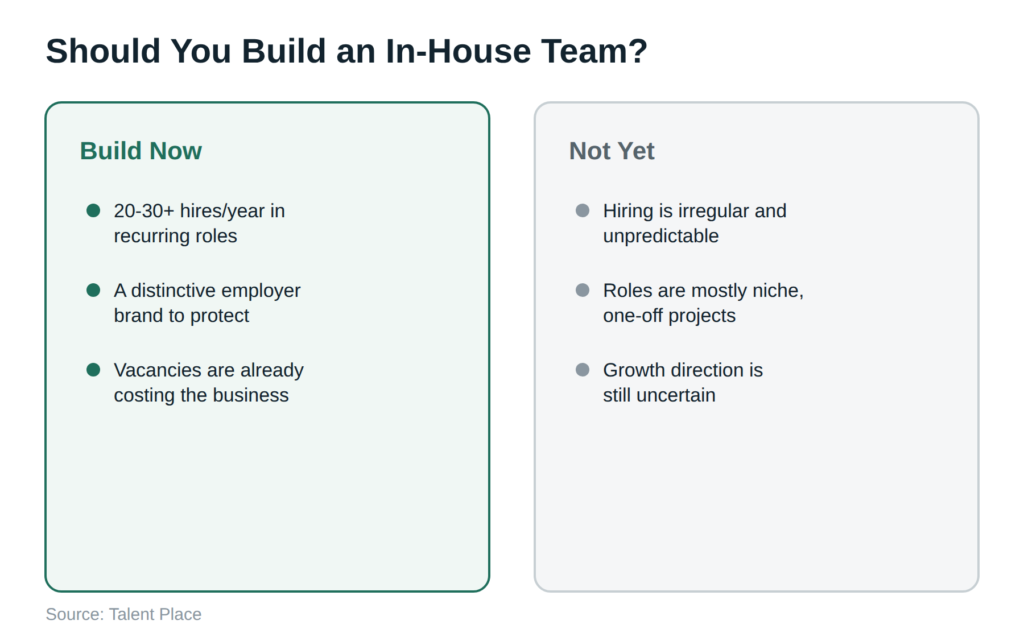
Three signs it’s time for your own team:
You’re hiring more than 20–30 people a year in recurring roles. If you’re filling similar positions every quarter — engineers, customer support specialists, analysts — it pays to build in-house knowledge of those roles and their sourcing channels. An outside agency starts from zero every single time.
You have a distinctive employer brand that an outside agency can’t faithfully represent. Culture, values, working style — these are things a recruiter who knows the company from the inside communicates naturally. An external agency will always operate with a certain information lag, and how well a company closes the loop with candidates after a process ends says a lot about whether that brand comes through consistently.
Time-to-fill has become a real cost. When an open role is blocking a project, delaying a product launch, or overloading the rest of the team, every week without a hire is a measurable loss. An in-house TA team can move faster than an outside partner.
Three signs an in-house team doesn’t (yet) make sense:
Hiring is irregular and unpredictable. If you need five people one quarter and none the next, a full-time recruiter will spend half their time looking for something to do.
Most of your roles are niche, one-off projects. Recruiting for C-level hires, domain experts, or roles that need rare skill sets — this is where an in-house recruiter often has neither the network nor the track record a specialized agency brings.
The company is still uncertain about its growth direction. Building HR infrastructure around a plan that might change is a hard risk to justify. In that situation, flexibility is worth more than permanence.
The key distinction here isn’t “in-house versus outsourced.” It’s a question of proportion — how much stability, how much flexibility, and how that balance shifts over time.
Three Models for Building a TA Team
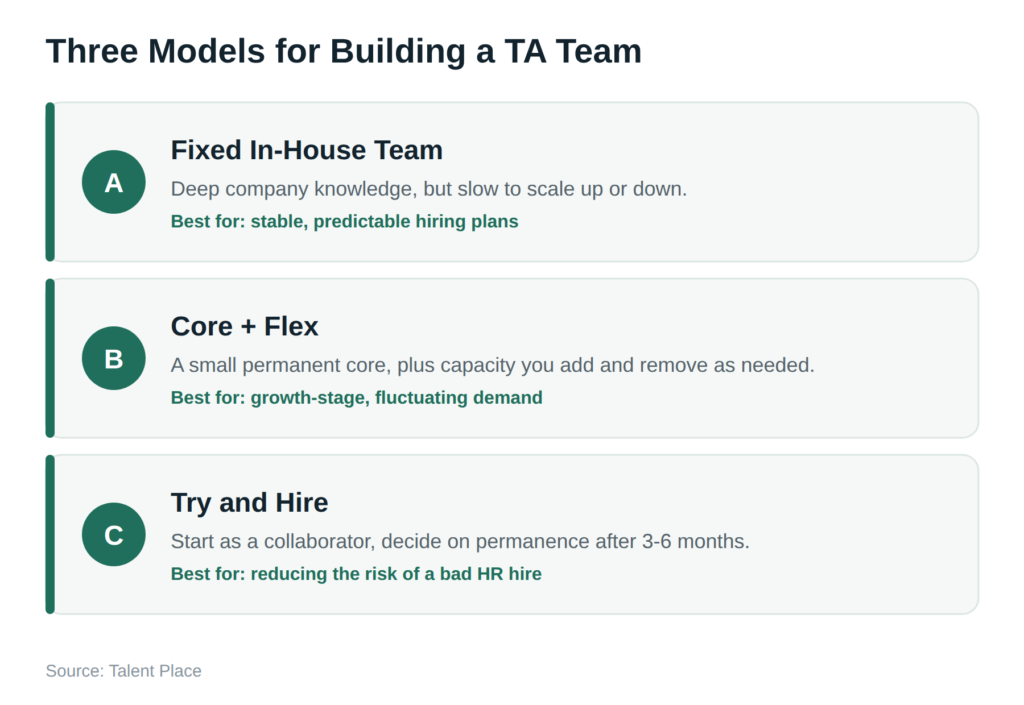
Companies that manage talent acquisition well rarely think in terms of “we have three recruiters.” They think of it as a system with a fixed baseline capacity and a flexible capacity that can scale on demand. Three models worth knowing:
Model A: A Fixed In-House Team
Recruiters on payroll or B2B contract, fully embedded in the company, fluent in its culture, processes, and hiring managers. Best when hiring is regular, predictable, and requires deep organizational knowledge.
The downside people rarely mention: this is the least flexible model. It’s hard to scale up quickly when the business suddenly accelerates — a recruiter new to the company needs months to become truly effective. And it’s hard to scale down when the headcount plan shrinks; restructuring HR is costly and emotionally difficult.
Best for: mature, stable organizations with a predictable hiring plan for at least the next 12 months.
Model B: Core + Flex
A small permanent core (one or two recruiters who know the company, its culture, and its processes) supplemented with additional capacity as needed. The core team owns quality standards, hiring-manager relationships, and process continuity. The flexible layer responds to projects, hiring spikes, new business lines, or new markets.
This is the most common model among mature organizations with fluctuating talent needs. It does require access to a trusted pool of recruiters who can jump in quickly, without a three-month onboarding runway — which is essentially what crowdstaffing was built to solve: adding recruiting capacity for a specific push without permanently expanding the internal HR department.
Best for: growth-stage companies, teams scaling into new areas, or businesses in industries with seasonal hiring patterns.
Model C: Try and Hire
A recruiter starts as an external collaborator — running specific projects, learning the company, while the company learns their working style and cultural fit. After three to six months, a decision gets made: permanent hire, or a clean, painless parting of ways.
This model removes the single biggest risk in hiring a recruiter: that someone performs beautifully across three interview rounds but, in practice, doesn’t mesh with the company’s working style, pace, or how it communicates with hiring managers. Recruiters are professional interviewers — evaluating them through the very process they run for others carries a structural bias. It’s the same logic behind Try&Hire as a contracting model: work together first, decide on permanence once there’s real evidence to go on.
Best for: companies that want certainty before committing to a permanent hire, or those that have been burned by a bad HR hire before.
How to Actually Recruit a Recruiter
Assuming you’ve decided to build a team — how do you pick the right person? Here’s the catch: recruiters know exactly how to get through any standard hiring process. Competency questions, behavioral interviews, motivation questions — that’s their bread and butter. Standard screening methods are the weakest possible filter for this particular group.
What to Actually Look For
Familiarity with the industry or role types the company mainly hires for. A recruiter who spent five years filling finance roles won’t overnight become an effective sourcer for embedded engineers. Specialization matters — and it’s worth verifying, not just taking on faith.
Sourcing skills that go beyond LinkedIn. Passive candidates rarely browse job listings. A recruiter whose entire sourcing strategy is built on InMail will struggle with roles that require reaching people who aren’t actively looking.
Their approach to candidate experience. A recruiter is often the first person a candidate interacts with on behalf of the company. How they run a conversation, how they follow up, how they handle rejection — all of it directly reflects on the employer brand.
Independence and comfort working with an incomplete brief. Hiring managers rarely know exactly what they want. A good recruiter doesn’t wait for a perfect job description — they ask the right questions to uncover the real need and work with what they have.
What Not to Ask (Even Though Most People Do)
“How many roles did you close last year?” A number without context tells you nothing. Closing five ML engineer roles in a year can be harder than closing fifty entry-level call center positions.
“What recruiting tools do you know?” Tools change fast. The ATS that was standard three years ago may no longer be in use. The ability to pick up new tools matters more than familiarity with old ones.
“Where do you see yourself in five years?” Recruiters know exactly how to answer this. It only filters out people who can’t improvise on the spot — which isn’t a particularly useful filter.
Three Questions That Actually Tell You Something
“Describe the hardest-to-find candidate you’ve ever sourced — where did you find them, and how did you reach out?” This tests real sourcing ability rather than a rehearsed familiarity with methods. A strong answer is specific — it names a platform, a channel, or a community where the candidate was actually present, and describes what that first contact looked like.
“How do you handle it when a hiring manager rejects a strong candidate for a vague reason?” This gets at how someone manages the hiring-manager relationship. A recruiter who accepts every decision unquestioningly isn’t a real partner to the business. One who goes straight to open conflict won’t function well inside the organization either. You’re looking for someone who can ask the right follow-up — “what specifically isn’t working?” — and steer that conversation constructively.
“Walk me through how you’d source for this exact role.” Hand them a real role — ideally one that’s currently open, or one you recently filled — and ask for a live demo. What search strings would they use, where would they look, how would they judge a candidate’s profile in the first thirty seconds? This is the one thing you can’t prep for in advance.
What Does a Bad Recruiting Hire Actually Cost?
Before you start building a team, it’s worth understanding what’s really at stake. The cost of a bad recruiter hire isn’t just their salary for the months before the company decides to part ways.
It’s the roles they filled badly, or didn’t fill at all — the cost of re-running that search and re-onboarding. It’s the candidates they burned with poor communication or a bad candidate experience — a reputational cost to the employer brand that’s hard to measure but very real. It’s the hiring managers they discouraged from actively partnering with TA — trust takes years to build and one bad conversation to break. This is the same dynamic pushing up the price of a failed hire across recruiting more broadly, and it only gets sharper for a role whose entire job is judging other people’s hiring risk.
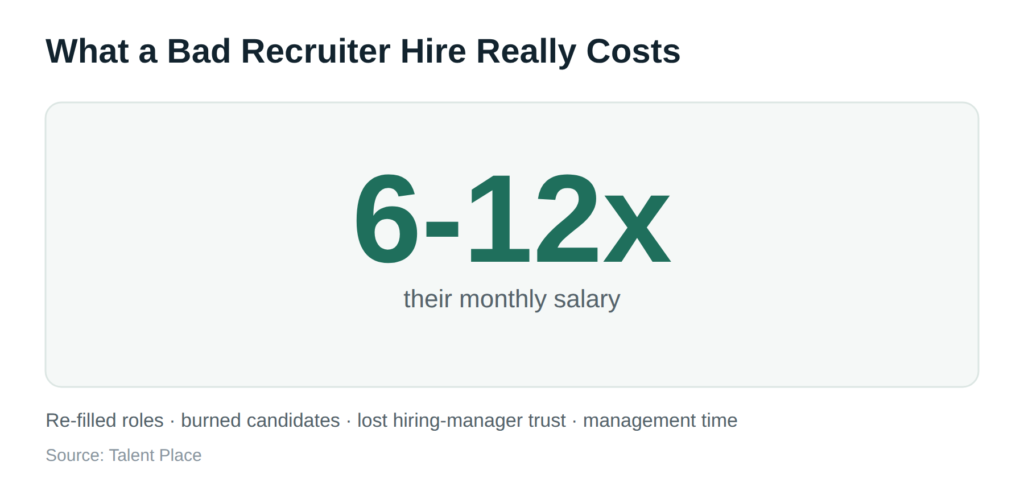
As a rough estimate: the cost of a bad recruiter hire runs six to twelve times their monthly salary, once you factor in wasted salary during ineffective months, the cost of re-filling the roles they got wrong, and the management time spent cleaning it up. That’s one reason the try-and-hire model makes particular sense for this specific role.
Flexibility as a Competitive Advantage
The companies winning the war for talent don’t have the biggest TA teams. They have the most flexible ones. They can add capacity for a new market or an intense hiring push within a week — and remove it within a month, without the pain of restructuring, without hard conversations about layoffs, without months of carrying headcount that’s no longer needed. It’s the same reasoning that leads plenty of teams to bring in contractors instead of full-time hires for time-boxed work — the goal isn’t a smaller team, it’s a team shaped like the actual workload.
That kind of flexibility isn’t achievable with full-time hires alone. It requires access to a trusted pool of recruiters — people who can be activated quickly, who understand different industries and role types, and who don’t need three months of onboarding to become effective.
More and more mature organizations have stopped asking “do we need a recruiter?” and started asking “what model do we need right now, and how will that change in six months?” That’s the right question.
The Talent Place Recruiter Community — When You Need Support, Fast
Talent Place has built something no traditional recruiting agency has: an active community of more than 400 experienced recruiters, freelancers, and HR experts, available for any of the models described in this article.
Here’s what that means in practice:
If you need a recruiter for a specific project — a week, a month, a quarter — we can get that collaboration running without weeks of onboarding. Recruiters in our network know their specializations, work independently, and are used to operating inside different organizational environments.
If you want to test the fit before making a permanent hire, our try-and-hire model lets you evaluate a recruiter based on real work, not an interview performance. After three to six months of collaboration, the decision to hire is based on facts, not on a gut feeling from a conversation.
If you’re building a core + flex model, we can be your flexible layer — a permanent core inside your company, with Talent Place supplying recruiters through our RPO model as the capacity you add when a project demands it and remove once it’s done.
A few numbers worth knowing:
- 600,000 candidates in our community’s contact database — reach that a single in-house team couldn’t build in years
- 95% success rate in candidate placement — the result of working on an exclusivity basis, not success fee
- First recommendations within 7 days of project kickoff
- Average time to fill: 3 weeks — against a market standard that’s often 6–10 weeks
- #1 on Clutch among the world’s top recruiting agencies, five years running (2020–2025)
We work across IT, AI & Data, BPO/SSC, Engineering, Marketing, and Sales — handling both one-off projects and long-term RPO arrangements, depending on what a company needs in a given moment.
If you want to figure out which model makes sense for your organization, let’s talk. We start with a short conversation about where your TA team stands today, and what you’ll need in 3, 6, and 12 months.