Same month, same company. The HR team closes out a search for a marketing specialist — dozens of applications, plenty of well-prepared candidates, the process wrapped up in two weeks. At the very same time, that same HR team has spent three months failing to find an industrial electrician for that same company’s production plant.
This isn’t a coincidence or an outlier — it’s an accurate snapshot of the Polish labor market in 2026. The question “is it an employer’s market or an employee’s market?” has stopped making sense, because the honest answer is: it depends who you’re asking about. In this article, we look at why white-collar professionals and technical specialists are now operating in two parallel realities — and how to adjust your recruitment strategy accordingly.
1. Two Realities — What the Numbers Say
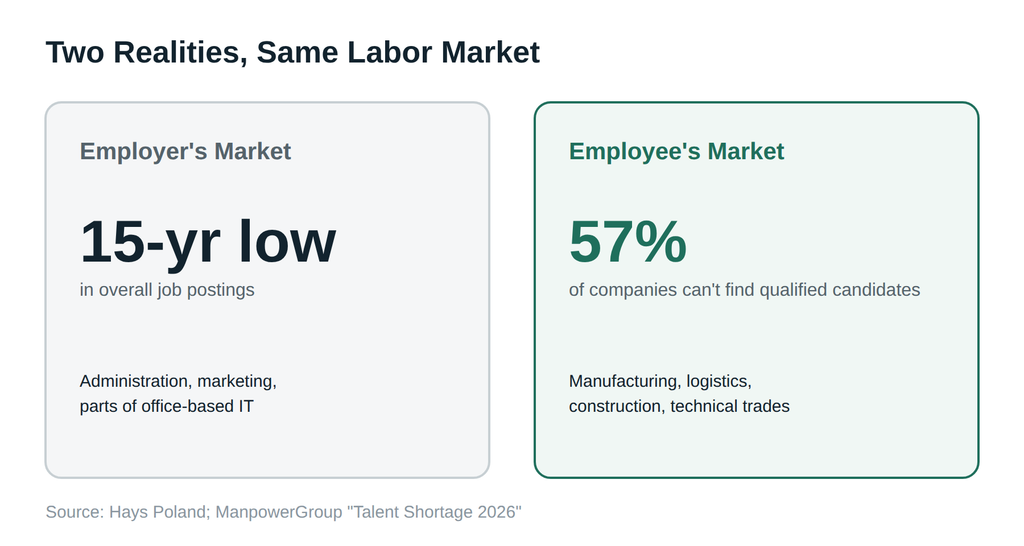
Data from the second half of 2025 showed that the overall number of job postings in Poland fell to its lowest level in 15 years, a clear sign of companies growing more cautious about hiring for office and administrative roles. That’s a strong “employer’s market” signal.
At the same time, according to ManpowerGroup’s “Talent Shortage 2026” report, as many as 57% of companies in Poland report difficulty finding candidates with the right qualifications — exactly the opposite signal. These two statistics aren’t contradictory. They simply describe two different segments of the same market.
| Employer’s Market | Employee’s Market | |
|---|---|---|
| Segments | Administration, parts of marketing and office roles, parts of IT | Manufacturing, logistics, construction, technical trades, medtech, green energy |
| Number of postings | Falling, companies more cautious about hiring | Growing or holding steady despite the broader slowdown |
| Who has the upper hand | The employer can pick and choose among candidates | The candidate is weighing several offers at once |
2. Why White-Collar Roles Have Shifted to an Employer’s Market
Several trends are overlapping here at once. Facing economic uncertainty, companies are pulling back on office-role hiring, and some administrative and analytical tasks are already being partially taken over by AI-based tools. The effect is visible on the candidate side too: despite the tougher market, as many as 63% of specialists and managers are considering changing jobs sometime in 2026 — a 15-percentage-point increase since the start of the year. At the same time, a growing share of respondents rate their career prospects negatively (35%), while only around one in three now rates them positively.
That’s an apparent paradox: more people want to change jobs, but they’re doing it far more cautiously and selectively than just a year ago. White-collar candidates apply less indiscriminately, and check more carefully whether an offer genuinely matches their skills before sending a CV. This is exactly the kind of selective candidate for whom simply speeding up the process isn’t enough — candidate experience and trust matter more than automation alone, because a selective candidate walks away at the first sign of chaos in the process, no matter how fast that process otherwise moves.
3. Why Technical Specialists Still Call the Shots
On the other side of the market, the picture looks completely different. Demand for technical and operational workers today is driven above all by logistics, e-commerce, manufacturing, and retail — these are precisely the sectors reporting the biggest talent gaps. Demand also remains high among specialists in technical trades, construction, healthcare, and the fast-growing defense industry.
Automation and robotics on the production floor aren’t reversing this trend — quite the opposite. New machines and systems still need people to install, operate, and repair them. The 2026 Occupational Barometer confirms this directly: electricians and power-industry technicians once again made the list of occupations in shortage nationwide, even though the overall number of shortage occupations fell in this edition of the study (to 17 out of 168 professions analyzed, down from 23 the year before). In other words: the labor market as a whole is cooling off, but not where hands and technical skills are in short supply. We covered this segment in more depth in a separate article on so-called “grey collar” workers — people who combine physical work with technical expertise, who today rank among the hardest candidates to find on the market.
4. What This Means in Practice — Two Different Recruitment Strategies
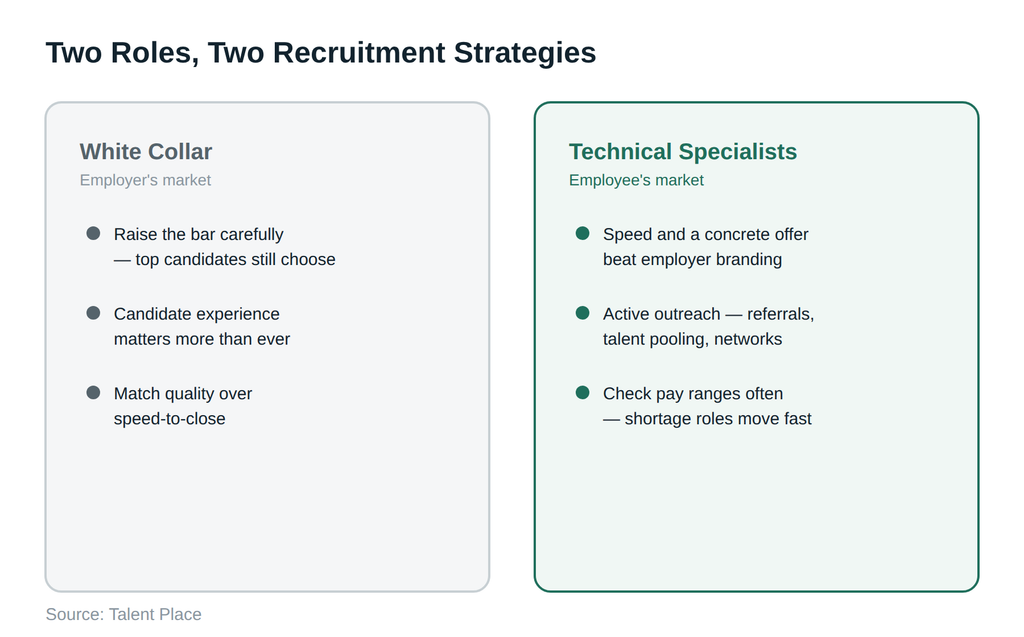
A company that runs the exact same hiring process for a marketing specialist and an industrial electrician loses out in both cases — just in different ways.
White-collar recruitment under employer’s-market conditions:
- You can raise the bar on requirements, but carefully — the best candidates still have options and drop out easily after a poor recruitment experience.
- Candidate experience matters more than ever — a selective candidate walks away at the first sign of chaos in the process.
- Match quality matters more than speed-to-close — you can afford a more thorough selection process.
Technical-specialist recruitment under employee’s-market conditions:
- Speed and a concrete offer matter more than employer branding — a candidate with the right credentials usually has more than one offer on the table.
- Active outreach is essential — referrals, industry networks, and systematically building your own candidate database, a talent-pooling model, instead of passively waiting for applications.
- Pay ranges need checking more often than once a year, because in shortage technical occupations the market can shift within a few months.
5. The Most Common Mistake: One Recruitment Strategy for Every Role
Many companies still apply the same process template — the same number of stages, the same sourcing channels, the same tone of communication — regardless of whether they’re hiring a financial analyst or a maintenance technician. A multi-stage, drawn-out process that works fine for office roles (since candidates are generally willing to wait) typically ends, for a technical role, with the candidate lost to a competitor who offered a faster decision. It’s the same structural mistake we described when discussing building a recruitment team that keeps pace with a company’s growth — a single rigid process, regardless of context, eventually stops working.
6. How to Check Which “Market” Your Role Is Really In
Before you open a search, it’s worth answering a few questions:
- How long did the last few similar searches in the same industry, for the same role, actually take?
- Is this occupation on the current Occupational Barometer’s shortage list?
- How many applications come in on their own, versus how many you have to actively generate through direct search or referrals?
- Has the competition in this segment recently raised pay, or are they holding off on hiring instead?
The answers to these questions will tell you far more than broad headlines about “the labor market” — because, as it turns out, there simply is no single, shared market anymore.
Are you hiring for office and technical roles at the same time, and finding that one process doesn’t work for both? At Talent Place, we’ve spent years combining white-collar and blue/grey-collar recruitment, matching sourcing channels and process speed to the realities of each specific market segment. Get in touch with us and let’s talk about your strategy.
Data sources: Hays Poland, “Labor Market 2026. Half-Year Trend Review”; ManpowerGroup, “Talent Shortage 2026”; Statistics Poland (GUS); 2026 Occupational Barometer, Ministry of Family, Labour and Social Policy.