Picture two recruiters. Same role to fill, same week, same budget. One works the way recruiters have worked for the last decade: LinkedIn Recruiter, a CV database, phone calls, notes in a spreadsheet. The other starts with AI.
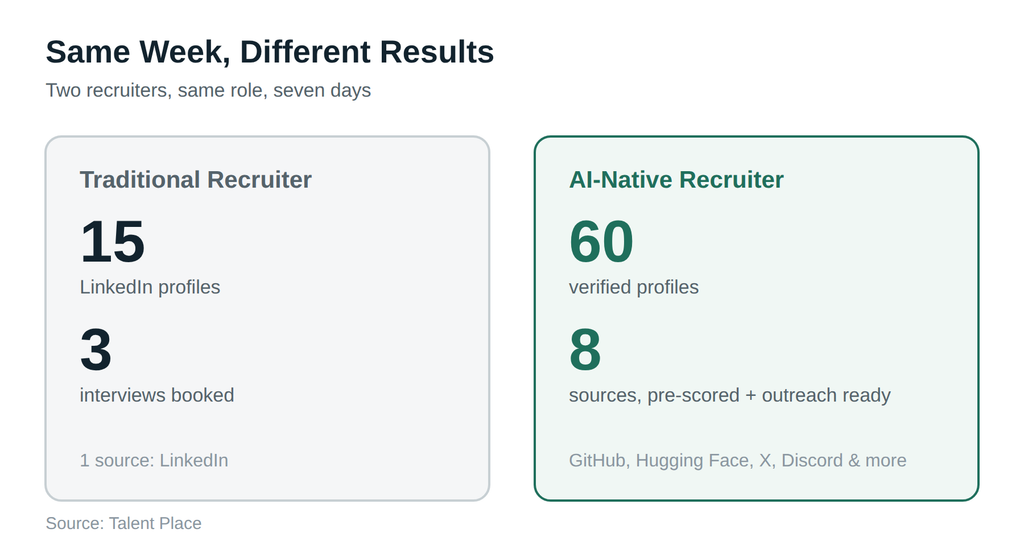
Seven days in, the first recruiter has fifteen LinkedIn profiles and three interviews booked. The second has sixty verified profiles pulled from eight different sources, pre-scored against the role’s criteria, with notes ready on every candidate and personalized outreach messages already drafted.
Where does the gap come from? An AI-native recruiter isn’t doing the same job faster — they’re doing fundamentally different work with the same hours. They deliver results a traditional recruiter can’t reach no matter how hard they push. Here are the four areas where that gap shows up most clearly, and what each one means for your company.
Sourcing: Scale and Reach You Can’t Get by Hand
Sourcing is where the gap between traditional and AI-native recruiting is easiest to measure.
A traditional recruiter works inside a narrow ecosystem: LinkedIn Recruiter, an internal database, job boards. Their reach covers candidates who are actively job-hunting or visible enough on those platforms to surface in a search. Sourcing a single role eats three to five days of focused work, and it draws from the exact same candidate pool every competitor is fishing in.
An AI-native recruiter starts from a different question: where does this candidate leave traces of their actual work? As we cover in more depth in our guide to finding AI-native talent beyond LinkedIn, the answer leads to GitHub, Hugging Face, Substack, Twitter/X, industry forums, Discord servers, and local communities. They use AI to search all of these at once and pull the results into a structured list — building queries around activity signals like recent commits, published articles, or community participation, instead of keyword-matching CVs.
A concrete example: a Senior ML Engineer role requiring RAG experience and familiarity with the Claude API. A traditional recruiter searches LinkedIn and turns up two hundred profiles with “machine learning” somewhere in their history — eighty percent of which miss the technical bar. An AI-native recruiter builds a query that scans GitHub for repositories built on LangChain and LlamaIndex, Hugging Face for published RAG models, and Twitter for people actually writing about the Claude API. Result: forty profiles, thirty-five of which clear the technical bar. Less work, higher hit rate, and access to candidates competitors never see.
For your company, that translates into a shorter time to the first recommendation and systematic access to passive candidates who never show up in standard sourcing. In niche roles, where the strongest practitioners rarely apply actively, this difference decides whether the search closes in a reasonable timeframe at all — one of the reasons we built our AI-Native Recruitment service, which delivers first candidate profiles within 72 hours of kickoff.
Screening: Judgment Quality, Not CV Volume
Screening is where a traditional recruiter loses the most time — and makes the most decisions colored by fatigue.
Decision fatigue when reviewing a hundred applications one CV at a time is well documented and very real. A recruiter evaluating the twentieth CV is thinking differently than they were on the first. A hundred applications means several hours of work, real risk of missing a strong candidate buried late in the stack, and real risk of waving through a weak one just because they applied first.
An AI-native recruiter changes the mechanism itself. Instead of reviewing CVs one by one, they define evaluation criteria as a structure AI can apply to every profile consistently, without fatigue. The key shift: they don’t ask AI “is this candidate good,” they ask “does this profile meet these specific criteria, and what’s the evidence.” We apply the same logic when assessing AI-aware versus AI-native fit — what counts isn’t what a candidate claims, it’s the concrete evidence in their actual work. The output is a structured, justified read on every profile, which makes for a fast, repeatable decision.
The time an AI-native recruiter invests goes somewhere else: precisely defining criteria up front and checking the quality of what the AI produces, rather than mechanically flipping through documents.
A concrete example: a hundred applications for a Product Manager role. A traditional recruiter needs four to six hours and delivers fifteen longlist candidates with a subjective rationale. An AI-native recruiter spends forty-five minutes defining criteria and checking the output, and delivers twenty-two candidates, each with a documented rationale and a criteria set that’s ready to show the hiring manager.
For your company, that difference lands in three places. Faster screening shortens the whole process. Less decision fatigue improves shortlist quality. Transparent, documented criteria make it far easier to explain to a hiring manager why these candidates made the list and others didn’t.
Candidate Communication: Personalization at Scale
Outreach to passive candidates is one of the hardest parts of recruiting. A candidate who isn’t job-hunting needs a reason to reply. A generic message doesn’t give them one.
A traditional recruiter has two options: send similar messages to many candidates (fast, but low conversion) or write genuinely personalized messages (effective, but slow). At real scale, the second option simply isn’t sustainable.
An AI-native recruiter escapes that trade-off by using AI to generate personalized messages grounded in each candidate’s actual profile — not just a first name and a company name, but a specific GitHub project, a published article, a community comment that shows what this person actually works on. The candidate gets a message that proves someone checked who they are before writing. As our review of AI recruiting tools points out, candidates spot context-free outreach almost instantly — an outreach tool without real segmentation behind it doesn’t get you very far.
The measurable effect: outreach to fifty passive candidates from a traditional recruiter typically gets an 8–15% response rate. The same outreach from an AI-native recruiter, for the same time investment, gets 25–35%.
Personalized recruiting communication is also an employer brand question. A candidate who receives a message showing the company genuinely noticed them walks away with a different impression than one who gets a mass message. In a market where strong candidates are weighing several offers at once, the quality of that first contact matters.
An AI-native recruiter also uses AI to prepare for the interview itself: a candidate brief, questions tailored to their specific profile, a read on culture fit based on public information. The conversation gets substantive from minute one.
Reporting and Analytics: Decisions Built on Data
Recruiting reports look the same at most companies: application count, interview count, offer count, time-to-hire. Historical numbers, delivered weekly or monthly, with no interpretation and no recommendation attached.
A traditional recruiter reports what happened. They rarely analyze why, and almost never forecast what’s next.
An AI-native recruiter builds reporting that answers business questions. Where in the funnel are we losing the strongest candidates, and why? Which sourcing channels deliver the highest-quality candidates at the lowest cost and time? How long do similar roles typically take, and what stretches them out? Does the profile of candidates who make it through the whole process differ from those who drop out — and at which stage? Answering these requires tying data from multiple systems into one coherent logic, which is exactly what we cover in our piece on orchestrating candidate sourcing — without it, even good AI tools produce scattered data that’s hard to compare.
Answering these questions means analyzing patterns across multiple processes at once. An AI-native recruiter uses AI to do that, and hands the hiring manager conclusions and concrete recommendations, not a status report.
For your company, that shift has a direct effect on recruiting budget decisions, how a recruiter’s time gets allocated, and how the process itself gets designed. A company that knows it’s losing candidates between the first and second interview can fix that problem. A company that only knows how many interviews happened doesn’t know where to look.
What This Looks Like in Numbers
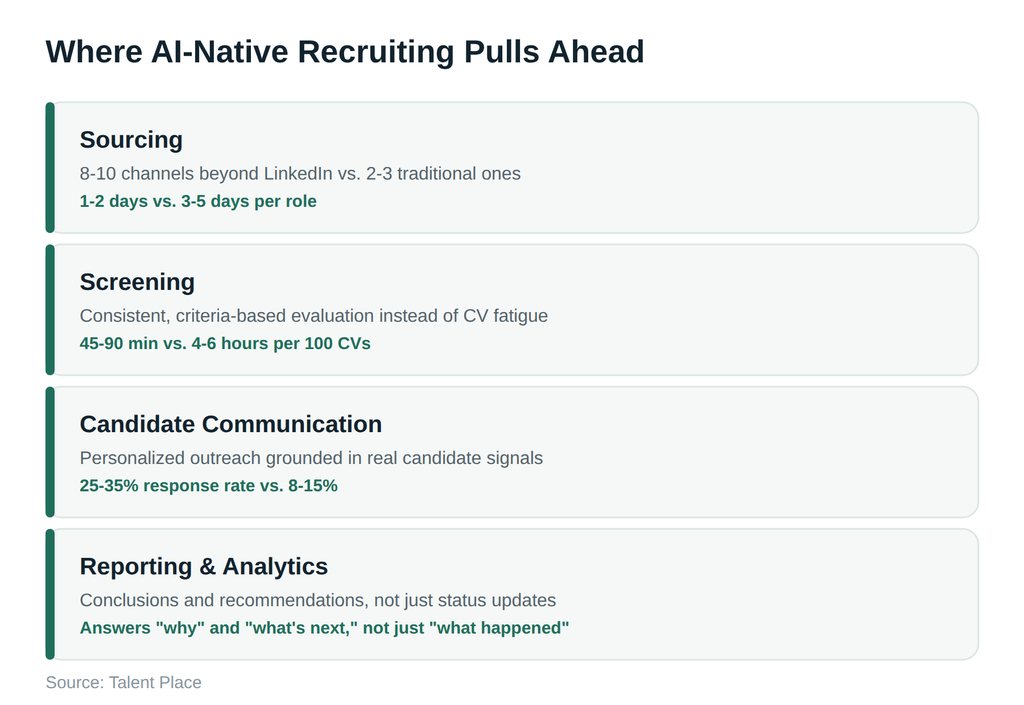
The figures below are estimates based on observations from recruiting processes run by AI-native recruiters. Actual results depend on the role, industry, and organization.
| Area | Traditional recruiter | AI-native recruiter |
|---|---|---|
| Time to source one role | 3–5 days | 1–2 days |
| Number of sourcing channels | 2–3 | 8–10 |
| Time to screen 100 CVs | 4–6 hours | 45–90 minutes |
| Outreach response rate | 8–15% | 25–35% |
| Time to first recommendation | 2–3 weeks | 5–10 days |
The gap in these numbers doesn’t come from clicking faster. It comes from a different read on where a recruiter’s time creates the most value. An AI-native recruiter delegates the repeatable, scalable work and puts their energy where human judgment actually matters: the candidate relationship, culture fit, and the conversation with the hiring manager.
What This Means for a Company That’s Hiring
Companies facing this decision have two paths.
The first is building an in-house team of AI-native recruiters. That takes time, the right selection process, and a plan for rolling out the tools — especially once a company is growing faster than its HR function and an in-house recruiting team stops keeping pace with the scale of hiring.
The second path is working with an agency whose recruiters already operate AI-native. That option is faster, but only if the agency genuinely has those recruiters, and using AI in the process is a real practice on every project, not a marketing line.
A company that doesn’t understand the difference between a recruiter who uses AI occasionally and one who’s genuinely AI-native will end up comparing agency proposals on price and promised turnaround alone. That’s not enough of a filter to make a good decision.
AI-Native Recruiters at Talent Place
At Talent Place, our network of more than 400 recruiters works with AI as a standard part of every project, not as an add-on to a traditional process. That means sourcing across multiple channels at once, screening built on structured criteria, and personalized outreach at scale.
Results we see across projects:
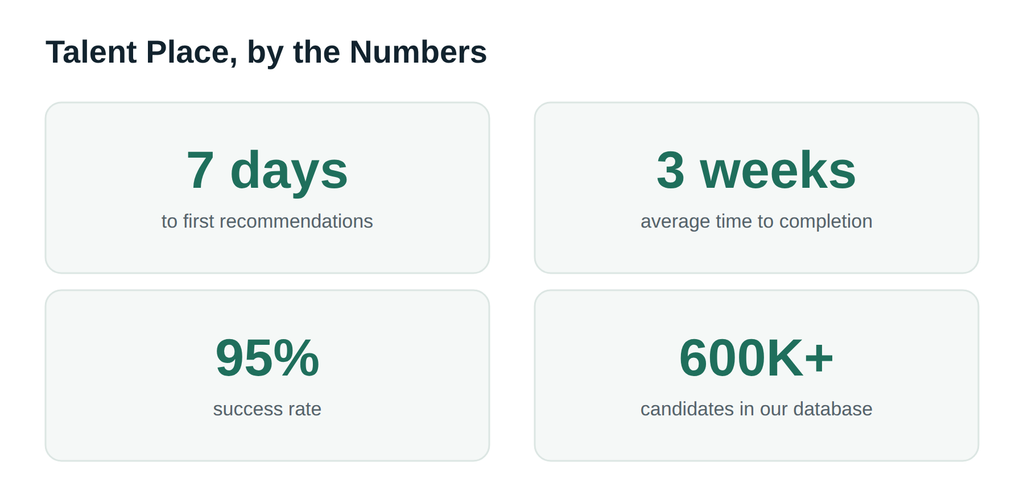
First recommendations reach the client within seven days of project kickoff. Average time to completion is three weeks, against a market standard that’s often six to ten weeks. Our success rate in securing candidates is 95%, the result of working on an exclusivity basis rather than success fee. Our community’s contact database exceeds 600,000 candidates, with reach into channels traditional sourcing never touches. You can see more concrete results in our case studies.
We work across IT, AI & Data, BPO/SSC, Engineering, Marketing & Sales, and C-level roles. We support one-off projects, RPO, and try-and-hire models, depending on what your company needs at a given moment — including through our own RPO model when internal capacity can’t keep up with hiring volume.
If you want to see what a recruiting project run by AI-native recruiters actually looks like, let’s talk. We start with a short conversation about the role and what you need, not a contract.