Picture a manager running an eight-person team today. A year from now, that same manager might be running four people and a couple dozen AI agents handling work that used to belong to the rest of the team. Does he understand the difference between those two jobs? Does he even know they are two different jobs?
The manager’s role used to shift over decades. Now it’s shifting by the quarter. Companies are baking AI into production processes, hiring AI-native specialists, and standing up autonomous agents to handle customer support, data analysis, and reporting. Middle management is picking up a whole new set of responsibilities — ones nobody prepared them for, and nobody’s saying out loud.
This isn’t an article about AI tools for managers. It’s about something deeper: what makes a good manager right now, and how fast that definition is moving out from under most organizations.
What’s Actually Changing
Let’s start with what this shift is not. It’s not that AI is “replacing” the team’s work — that framing is too easy, and it gets repeated far too often. What’s really happening is more subtle and harder to manage: the line between human work and machine work is turning fluid, and it’s the manager’s job to understand that line, draw it, and actively manage around it.
Three shifts are already underway — not in five years. Now.
Output speed is climbing, and so is the risk of quality slipping through the cracks.
An AI-assisted team produces more of everything — more copy, more analysis, more code, more proposals, more decisions. A manager who used to review ten deliverables a week is now looking at forty. The question stops being “is this done?” and becomes “is this good, and do we actually understand why?” That’s a fundamental shift in what a manager has to be able to evaluate, and how they spend their time.
AI agents are becoming team members in every operational sense.
Companies are standing up agents for customer support, report generation, anomaly detection in data pipelines, multi-step task execution. An agent doesn’t show up to the standup. It won’t Slack you that it’s stuck. It doesn’t understand organizational context nobody bothered to explain to it. A manager needs to know what the agent is doing, when to step in, and — this is the part that matters most — who’s on the hook when it gets something wrong. The agent isn’t accountable. The manager is.
AI-native people and AI-skeptical people operate completely differently on the same team.
This is a new kind of diversity-management problem — not cultural, not generational, but technological. One team can have a developer who’s rebuilt his entire workflow around AI assistants and is shipping three times what he did a year ago, sitting right next to an analyst who treats AI as a gimmick and works exactly the way she did last year. Distinguishing genuine fluency from surface-level familiarity isn’t always obvious at a glance, which is why some managers now borrow the same behavioral interview techniques recruiters use to verify AI skill — a specific recent example, a documented failure, a described verification habit — to figure out where each team member actually sits. The manager has to manage both — measuring them differently, coaching them differently, planning their growth differently.
Three Manager Roles That No Longer Hold Up
Real thought leadership means saying the uncomfortable thing out loud. So let’s say it plainly: a chunk of what managers have spent the last twenty years doing is either irrelevant now or fully automatable. And the organizations that won’t admit that are going to pay for the denial.
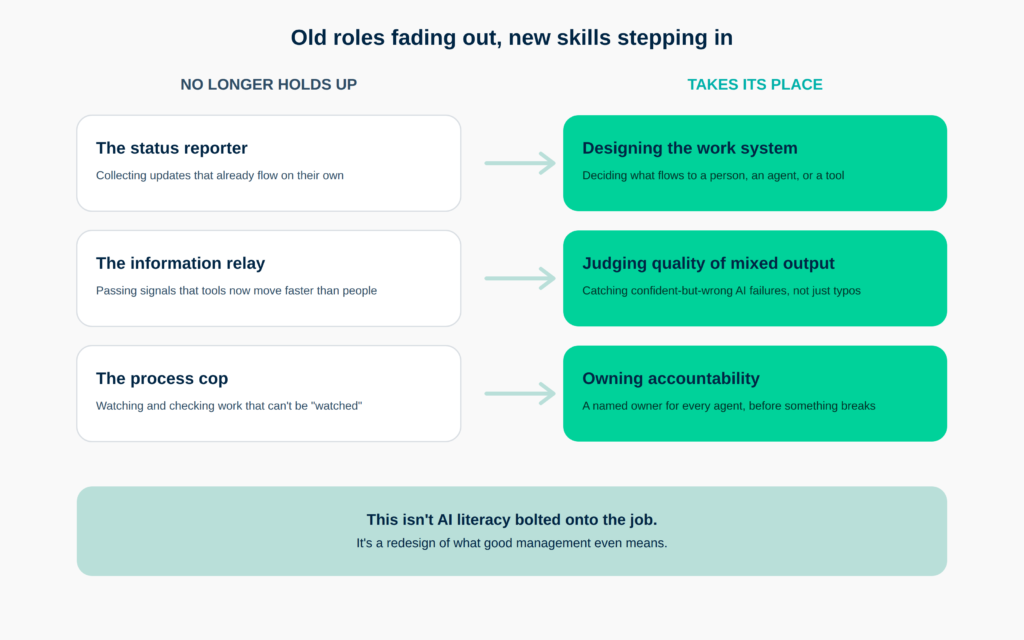
The status reporter.
Weekly “what did you work on this week” and “where’s the project at” check-ins were a necessity back when information didn’t flow on its own. Today it does — through project tools, dashboards, agent logs, automated system reports. A manager spending two hours a week collecting statuses instead of interpreting the data those statuses generate is burning their own time and the team’s. That’s not diligence. That’s a ritual from a previous era.
The information relay.
The manager as the communication node between leadership and the team — translating decisions downward, rolling signals upward — is losing its purpose in organizations where information can travel faster through tools than through people. A manager’s value was never in relaying. It’s in supplying the context that raw information doesn’t carry on its own — prioritizing, interpreting, deciding what actually matters.
The process cop.
Managing by watching and checking — “is it done,” “are you following the process,” “walk me through where you’re at” — doesn’t scale in a world where part of the work is done by tools and agents that can’t be “watched” in any traditional sense. Process control is being replaced by something harder and more important: output quality control. And that’s a shift most managers simply aren’t ready for.
Three New Skills That Define the AI-Era Manager
If those three roles are losing their footing, what’s taking their place? This isn’t about tacking “AI literacy” onto a manager’s skill list. It’s a genuine redesign of what good management even means.
Designing the work system, not assigning tasks
A good manager in the AI era doesn’t ask “who’s going to do this?” — they ask “how should this flow through the system so it gets done well and fast?” That means a whole category of decisions no one used to expect from a manager: which tasks go to an agent, which go to an AI-native specialist, which require human judgment that can’t be automated — and why. The manager becomes a workflow architect, not a task dispatcher. Recruitment teams have run into the same problem from the other side: buying a tool before deciding which stage of the process it should actually own tends to add a layer of work instead of removing one — the same discipline applies to deciding what a team’s AI agents are actually for.
In practice, that looks like this: before a new project kicks off, the manager can actually sketch its workflow — where AI enters, where a human enters, where the quality checkpoint sits, and what happens when something breaks. That’s not a slide for a deck. It’s a working map of the system they’re about to run. This is close to what’s known in AI-heavy operational teams as orchestration — connecting tools, data, and human decisions into one coherent process instead of a pile of disconnected features, and the same logic scales down to a single team’s daily workflow.
This skill requires something you can’t pick up from a management textbook: understanding AI’s capabilities and limits well enough to make design calls with it. The manager doesn’t need to know how to prompt a model. They need to know what a model is good at, what it’s bad at, and what it costs to get that distinction wrong.
Judging quality in a world of mixed output
When some deliverables come from people, some from AI tools, and some from agents running autonomously, quality assessment gets both more complicated and more important than ever. It’s a whole new form of performance evaluation — extended to cover a new kind of “employee” that doesn’t understand feedback and doesn’t learn from a conversation.
A good manager in this environment can do three things.
First, they can define “good output” with enough precision to actually communicate it to a model or an agent. If they can’t define it, AI will produce something that looks right but isn’t what’s actually needed. This is one of the most underrated management skills of the AI era: the ability to articulate quality standards with real precision.
Second, they understand that AI output and human output are different categories of output, with different categories of failure. A person makes mistakes from being distracted, tired, or under-informed — those errors are predictable and legible. AI fails in ways that are often much harder to catch: the output looks correct, reads confidently, and is flatly wrong. A manager who evaluates AI output the same way they’d evaluate a person’s work misses the most dangerous failure mode of all.
Third, they build verification systems, not gut checks. “I skimmed it and it looks fine” isn’t quality control in an AI environment — it’s the illusion of quality control. A good manager knows how to build a repeatable verification process that doesn’t depend on whether they happen to have the time and energy to check closely that day.
Owning accountability in a system with no obvious author
This is the hardest and most important of the new skills. When an agent wrote the report, an AI-native developer designed the prompt, a different system supplied the data, and a manager made a call based on that report — who’s accountable when the report is wrong?
In an AI-powered world, accountability doesn’t disappear. It just stops being obvious — and that’s exactly what makes it dangerous. Organizations that don’t establish an accountability structure before their first serious AI system failure will end up building that structure under crisis pressure instead. It’s a version of the same conclusion HR teams have been reaching about their own function: AI doesn’t eliminate roles so much as it strips out the repeatable pieces and leaves the judgment-heavy parts — and someone still has to own those parts explicitly, rather than assuming they’ll sort themselves out.
A good manager builds this structure ahead of time. In practice, that comes down to one simple rule: every agent or AI tool running inside the team has a named owner — a person accountable for its configuration, its monitoring, and its output. Owning an agent isn’t a technical admin role. It’s being the person responsible for making sure the agent does what it’s supposed to, the way it’s supposed to, and that mistakes get caught before they cause damage.
Simple in theory. Hard in practice — because it means a manager has to openly admit their team isn’t made up entirely of people anymore.
How to Track People and Agents
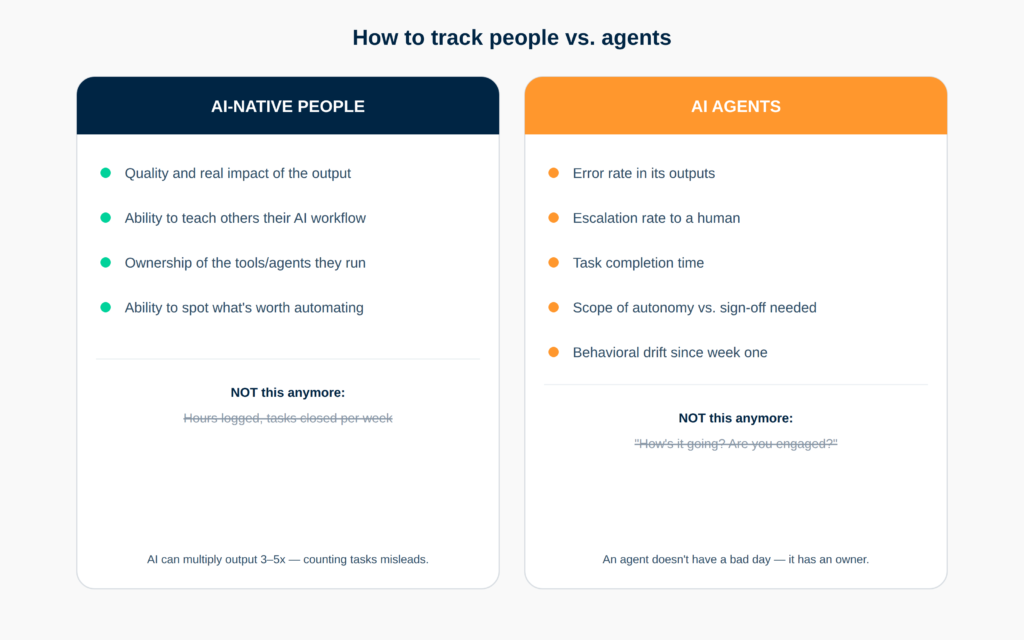
The tracking question is really a question about what you’re measuring in the first place. And here’s the problem: most team-performance measurement systems were built for a world where every output has a human author and every hour of work is roughly interchangeable.
Neither assumption holds anymore.
AI-native people need to be tracked differently than traditional employees.
Time-based and task-count KPIs stop meaning much when AI can multiply someone’s output three to five times over. A developer who closed four complex tickets this week using Cursor and Claude did more real work than a developer without AI who closed eight simple ones. Counting tasks is actively misleading here.
What to measure instead: the quality and real impact of the output on the project, the person’s ability to teach others how they’re using AI, ownership of whatever tools and agents they’re managing, and — hardest to measure, but the most valuable — the ability to spot tasks worth automating before anyone else thinks to.
Agents get tracked like systems, not like people.
An agent doesn’t have a bad day. It’s not motivated or demotivated. It doesn’t understand context that wasn’t explicitly handed to it. Which means the classic manager questions — “how’s it going?”, “what’s blocking you?”, “are you engaged?” — don’t mean anything applied to an agent.
The metrics that actually matter for an agent: error rate in its outputs, escalation rate (how often it hits something it can’t handle and kicks it to a human), task completion time, scope of autonomy (what it can do unsupervised vs. what needs sign-off), and — critically — behavioral drift over time (is an agent that’s been running for three months still behaving the way it did in week one, or has it quietly drifted?).
Every agent should go through a regular review — not a performance review, an operational audit. Who runs it? The agent’s owner: the person accountable for it.
The AI-era manager’s dashboard looks different.
Instead of “how many tasks did each team member close this week” — it’s “what outputs came out of the system as a whole, how good were they, where did things break down, and who or what is accountable for that.”
This isn’t just a change in tooling. It’s a change in how a manager thinks about their own job. Running a mixed human-and-agent team requires systems thinking — looking at the workflow as a whole, not at individual scoreboards.
Three questions a good manager should be asking themselves every week:
One: Which outputs from this week fell below the bar — and was that a human error, an agent error, or a system-design error that put a person or an agent in a bad position to do good work in the first place?
Two: Where is AI generating work I never asked for — and is that good or bad? Agents and AI tools can conjure up work that didn’t exist before: reports nobody reads, “optimized” processes that didn’t need optimizing. A manager needs visibility into those side effects.
Three: Which part of the system — a person, an agent, a tool, or a process — is the real bottleneck on the whole thing? And what can actually be done about it?
What This Means for HR and the C-Suite
Up to this point, I’ve been writing mostly to managers. But if you’re reading this as someone responsible for hiring or developing managers inside your org — this section is for you.
Hiring a manager today without assessing their readiness to run a mixed AI-and-human team is a mistake. Not because every manager needs to know how to prompt a language model. It’s because a manager who doesn’t understand how AI is reshaping workflow and accountability structure will manage their team using last decade’s playbook — in good faith, because nobody told them anything had changed. If part of the answer is bringing in someone who already thinks this way, that’s really a hiring question, and it’s worth treating AI-native recruitment as its own distinct search rather than a variation on a standard management hire.
How do you actually assess a manager’s readiness, whether in an interview or a development program? Three questions that say more than the standard competency-interview fare:
“Walk me through how you track your team’s work — what you measure, and why.” A manager who’s ready for an AI environment describes a system built around output quality, not hours worked or tickets closed. They talk about what their team actually produces and how they judge whether it’s good. If the answer is “we do weekly status meetings” — that’s an answer from a previous era.
“Have you managed a project where part of the work was done by AI tools or agents? What did quality management look like?” A candidate who’s never managed a mixed team will answer vaguely or not at all. A candidate with real experience will describe specific challenges: how they verified outputs, who owned the agent, how they responded when something broke.
“How do you decide which tasks go to people and which get automated or handed to AI tools?” This tests systems thinking. “It depends on the task” with no follow-through is a dodge. A strong answer names actual criteria — what makes a task belong to a human, and what makes it belong to a system.
Not having sharp answers to these isn’t disqualifying — it’s informative. It tells you whether this candidate has already managed in an AI-native environment, or is about to learn on the job. Depending on your organization and where it is in its own transformation, that might be perfectly fine — or it might not be.
The Bottom Line
A good manager has always been a translator — between strategy and execution, between what the organization wants and what’s actually achievable. In the AI era, they’re translating more languages at once: human, machine, and system.
They need to understand what an agent can and can’t do. They need to know when AI output is genuinely good versus when it just looks good. They need to build accountability structures inside systems where accountability isn’t obvious anymore. And they need to do all of that while managing people who each have a wildly different relationship to these changes.
This isn’t a forecast. It’s a description of what the best organizations and the best managers are already doing. The question isn’t “will my managers eventually need this skill set” — it’s “do they already have it, and how do I know.” If you’re wrestling with that question for your own organization, our team is happy to talk it through.