A recruiter is the one candidate who professionally coaches other people through interviews for a living. They know behavioral technique, they can tell a STAR-method story in their sleep, and they understand exactly what’s being tested on the other side of the table. A standard interview process is a warm-up for them, not a challenge.
Now add AI to the mix. “I use AI tools in my daily work,” “I optimize processes with AI,” “AI-driven recruiter” — these phrases show up on nearly every profile today, regardless of actual skill level. Adding them to a LinkedIn profile takes under a minute and costs nothing.
The result: a standard interview process barely differentiates candidates on AI at all. A recruiter who fires up ChatGPT once a week to draft a job ad will sail through a conventional interview exactly as smoothly as one who has rebuilt their entire workflow around AI. You need a different approach.
What to Look for in a CV and LinkedIn Profile
Before you even get to the interview, a CV and LinkedIn profile say more than you’d think — if you know what you’re looking for. Don’t look for a list of tools. Look for evidence of real work.
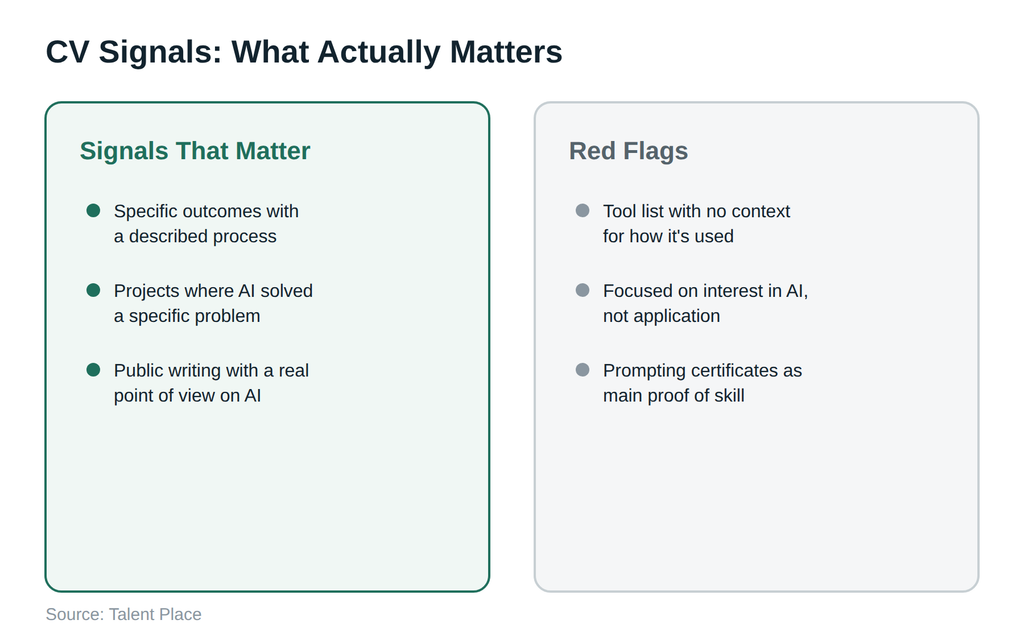
Signals That Matter
Specific outcomes with a described process, not just a list of duties. “I cut screening time for 100 applications from four hours to 45 minutes by building a structured, AI-based scoring system” tells you far more than “I use AI in my daily recruiting work.” The first sentence contains a problem, a solution, and a result. The second is a slogan.
Project descriptions where AI solved a specific problem. Not “I use ChatGPT for sourcing,” but “I built a screening system based on defined criteria that cut evaluation time while holding shortlist quality steady.” A strong description includes the problem’s context and the approach taken, not just a tool’s name.
Public activity connected to AI in recruiting. Articles, LinkedIn posts with a real point of view and concrete takeaways, participation in recruiting communities discussing AI. A candidate who writes regularly about how AI is changing their work, with their own perspective, leaves readable traces of their actual skill level. We describe a similar mechanism when assessing the difference between AI-aware and AI-native — claiming to know about AI is different from having a genuine AI-driven work habit, and the second only shows up in specifics.
Red Flags
A tool list with no context for how it’s used. “ChatGPT, Copilot, Claude, Gemini” in a skills section verifies nothing. Every one of those tools can be added to a CV without ever having been used.
Descriptions focused on interest in AI, not application. “I follow AI trends in recruiting,” “I’m interested in new tools” — these are the words of an observer, not a practitioner.
Prompting certificates presented as the main proof of skill. The AI certification market is too young to carry real verification weight. A certificate signals interest in the topic, not the ability to apply it to actual recruiting work.
Five Questions That Actually Verify Skill
This is the heart of the verification process. Each question is designed so a good answer is nearly impossible to fake without real hands-on experience with AI. Format: the question, what to listen for, and the red flag. We apply the same logic in our piece on verifying whether a candidate really works with AI — that version is role-agnostic; this one is built specifically for recruiters.
Question 1 Describe a specific recruiting process where AI changed your approach to sourcing. Where did you used to look for candidates, where do you look now, and what’s the difference in results?
What to listen for: a specific role, a specific channel shift, a specific difference in results. An AI-native candidate talks about GitHub, Hugging Face, Discord servers, industry Substacks, niche forums — not LinkedIn as the only channel. They describe how they build sourcing queries and how they check the quality of what they find. They give numbers: how many profiles, what share matched the criteria, how time-to-first-recommendation changed.
Red flag: an answer centered on a tool instead of a process. “I use a sourcing AI tool to search LinkedIn” describes a tool, not a change in approach. No concrete numbers, dates, or role names attached to the change.
Question 2 Walk me through your screening process when you have a hundred applications. Show me how you define criteria and where AI fits into that.
What to listen for: the candidate describes translating role requirements into structured evaluation criteria that AI can apply consistently to every CV. They understand the difference between “asking AI to judge a candidate” and “defining criteria AI checks against every profile.” They talk about verifying AI’s output before making a final call, and they can describe how they communicated those criteria to a hiring manager.
Red flag: the candidate describes AI as a way to speed up reading CVs without changing the evaluation mechanism itself. “I paste the CV into ChatGPT and ask if the candidate fits the role” is tool use, not an AI-native approach. No awareness of the risk in blindly accepting AI’s output.
Question 3 Show me an outreach message you recently sent to a passive candidate. Where did AI come into writing it, and what was the result?
What to listen for: an actual message, or a detailed description of its structure, with visible personalization grounded in the candidate’s real profile — a specific project, an article, activity in a community. A described process of drafting with AI and reviewing before sending. The candidate can state the response rate and what they changed in the next iteration. A strong answer includes some reflection on what worked and what didn’t.
Red flag: no concrete example, or an example that’s a lightly personalized template with a first name and company name as the only personalized elements. A candidate who doesn’t remember their last outreach message or its results probably doesn’t treat this as a process worth optimizing.
Question 4 What’s something that recently went wrong when you used AI in recruiting? What did you do with that experience?
What to listen for: anyone who genuinely works with AI intensively has a failure story. The model misjudged a candidate. It generated an outreach message that missed the context. It suggested a sourcing channel that didn’t pan out for that particular role. A strong answer is specific and shows how the candidate adjusted their process afterward. A mistake is a chance to learn AI’s limits, not something to sweep under the rug.
Red flag: no example of a mistake at all, or a generic answer like “AI isn’t perfect sometimes, but it generally helps.” No mistakes usually means no real, intensive use. Someone who uses AI daily runs into its limits regularly.
Question 5 How do you report the impact of AI in recruiting to your manager or client?
What to listen for: the candidate can describe specific metrics they track and present: reduced screening time, higher outreach response rates, a shorter time-to-first-recommendation, better longlist quality measured by advancement rate to later stages. They understand that AI’s value has to be communicated through results, not a list of tools adopted.
Red flag: “I tell them I use modern tools and it speeds things up.” No measurement or reporting of impact suggests AI is being used superficially, without real awareness of its effect on actual recruiting outcomes.
The Live Task: Verification You Can’t Fake
Interview questions test knowledge and reflection. A live task tests what a candidate does instinctively under time pressure — a similar format to the one we use when verifying AI-native developers: don’t judge the output, watch how they get there.
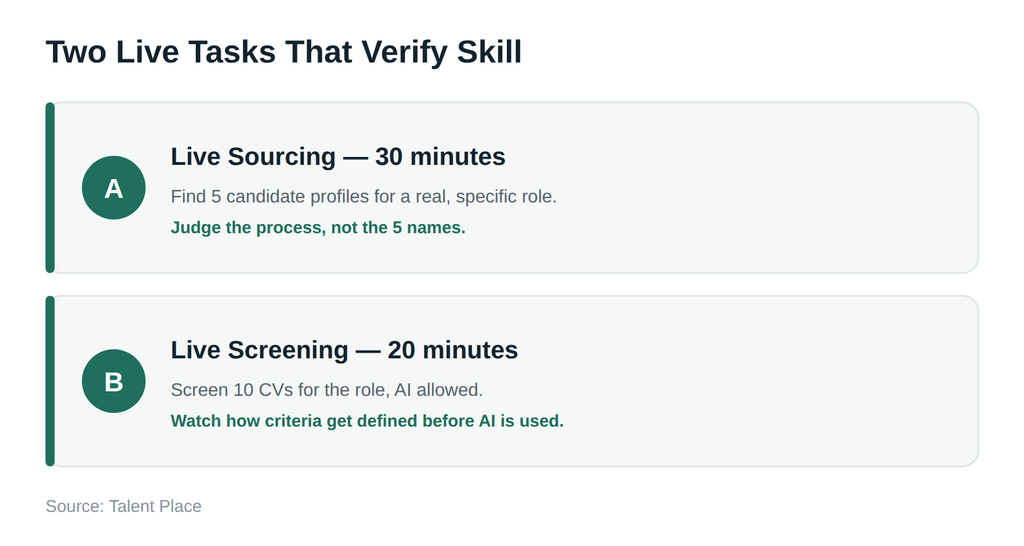
Task A: Live Sourcing (30 minutes)
Give the candidate a specific role, ideally one that’s currently open or was recently filled, so you can judge the result against your own experience with it. Say: “You have thirty minutes. Find me five candidate profiles for this role. Use whatever tools you want.”
Don’t evaluate the five profiles. Evaluate the process.
Does the candidate start by understanding the role, or by opening LinkedIn? How do they phrase their first query, and do they adjust it after seeing results? Do they look beyond standard channels, and if so, how do they get there? How do they evaluate the profiles they find before showing them to you? Do they check the quality of their own sourcing before declaring themselves done?
Task B: Live Screening (20 minutes)
Give the candidate ten CVs and ask: “Screen these for this role. You can use AI. I want to see how you work, not just the final list.”
What to watch for: do they define evaluation criteria before they start reading? Do they use AI to mechanically speed up reading, or to structure the evaluation? How do they react when AI’s output and their own instinct disagree? Can they justify every decision against a criterion, rather than a vague impression?
The Follow-Up Question
“What would you do differently if you had two days instead of thirty minutes?”
The answer reveals how deeply the candidate understands the process and how mature their thinking about AI as a tool actually is. A candidate who describes doing more of the same is thinking quantitatively. One who describes a different process structure is thinking systemically.
What Not to Ask
A few questions that sound reasonable but, in practice, don’t differentiate candidates in this group at all.
“Which AI tools do you use?” Tools change every quarter. A tool list says nothing about how well someone uses them. This question rewards candidates who track the news cycle, not the ones who work deeply with AI.
“How would you rate your AI skills on a scale of one to ten?” Self-assessment in this area tends to run inversely to actual skill. Advanced practitioners rate themselves cautiously, because they know how much they don’t know. Candidates with shallow experience often rate themselves highly, because they don’t know what they’re missing.
“Do you think AI will replace recruiters?” This question tests opinions, not competence. Every candidate has a diplomatic answer prepared. Time spent on this discussion is time taken away from verifying what actually matters.
“How will AI change recruiting over the next five years?” A question for a columnist, not a practitioner. A good answer here guarantees nothing about how the candidate actually works today.
How to Evaluate Public Activity Before the Interview
Thirty minutes spent on LinkedIn and Google before the interview often tells you more than the first half of the interview itself. It’s the same instinct worth applying when hiring for the recruiter role itself — a broad, active network and visible community involvement say more than the claims on a CV.
LinkedIn: does the candidate publish content about recruiting and AI with a genuine point of view, or just reshare other people’s articles? Comments under other recruiters’ posts where the candidate says something specific about a process or tool are a better signal than ten of their own posts full of generalities about “the future of recruiting.”
Articles and longer writing: valuable writing describes decisions and trade-offs, not just steps. “Why I stopped using X for screening, and what I did instead” has depth. “Seven AI tools you need to know in 2026” is surface-level.
Community activity: does the candidate take part in discussions about AI in recruiting on LinkedIn groups, HR forums, industry Discords? An active participant who answers other people’s questions or asks technical ones is a clearly different signal than a lurker.
No public activity at all isn’t disqualifying. But its presence and quality is one of the hardest competence signals to fake.
The Bottom Line
A recruiter who genuinely works with AI has that proven in results and process, not in a tool list under skills. Verifying it takes questions and tasks that can’t be prepared for without real experience. A standard interview process doesn’t get you there, because a recruiter knows that process from the inside better than candidates for almost any other role.
The protocol in this article works whether you’re hiring for your own in-house TA team or evaluating an agency’s recruiters before you commit to working with them. Either way, the question is the same: has this person actually changed how they work, or just changed the vocabulary on their CV?
If you’re looking for AI-native recruiters for your team, or want to work with an agency whose recruiters operate this way on every project, let’s talk. At Talent Place, our network of more than 400 recruiters works with AI as the standard on every recruiting project — not the exception, and for when your own internal team can’t keep up with hiring volume, our RPO model adds recruiting capacity on demand.