November 20th. Order volume at an online store is climbing day by day, and customer service has two people on shift instead of six. The warehouse is packing late into the night, and the e-commerce manager who was supposed to be running the Black Friday campaigns is still serving out notice at their previous company. The job ads have been up for a week, because “surely someone applies around this time of year.”
No one applies, because everyone is recruiting in the same week. Black Friday isn’t a surprise. It’s been on the calendar for years, and yet companies still treat building out the team as a last-minute task. In this article, we show how to flip that logic: who you’re actually competing with for people, which roles need the longest lead time, and how to build a hiring schedule by working backward from the date itself.
1. You’ve Seen This Peak Before — and It Keeps Getting Bigger
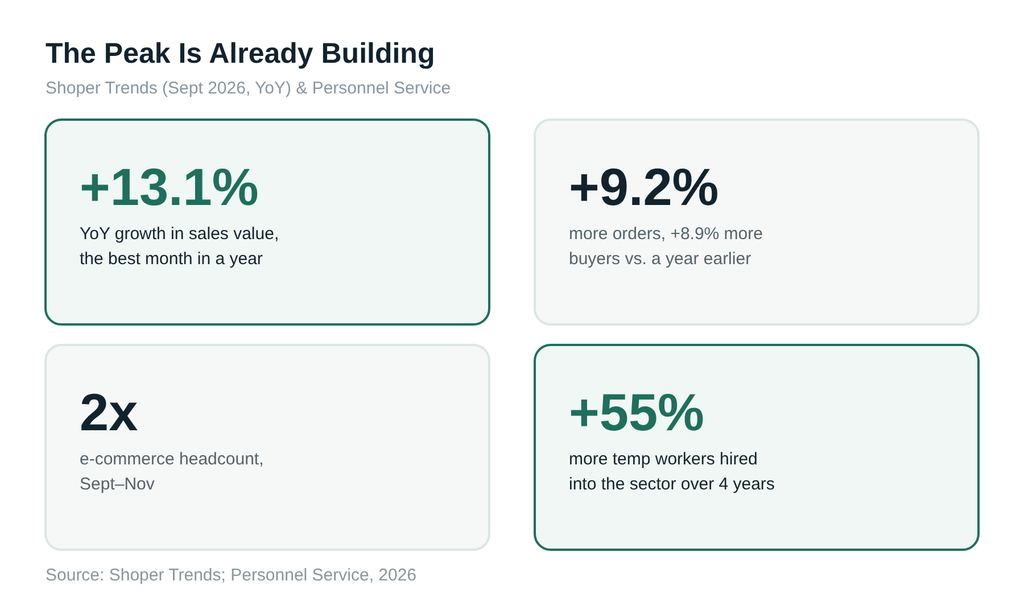
Black Friday 2026 falls on November 27th. Data from Shoper Trends, based on transactions across roughly 20,000 stores running on the Shoper platform, shows that September 2026 brought a 13.1% year-over-year increase in sales value — the best result of the past 12 months. Order volume rose 9.2%, the number of buyers rose 8.9%, and average basket value reached 409.48 PLN. The report’s authors note this reflects a single platform, not the whole market, but the direction is clear: traffic is already rising well before the peak itself hits.
On the hiring side, the picture looks much the same. According to Personnel Service, e-commerce headcount can roughly double between September and November, and the number of temporary workers hired into the sector has grown 55% over four years. Which means that in those same months, a lot of companies are chasing the exact same pool of people.
2. Who You’re Actually Competing With for People
A company hiring seasonal staff for one warehouse or one customer service desk rarely sees who else is drawing from the same candidate pool. Just look at the biggest player in the market. Amazon announced it’s hiring more than 10,000 seasonal workers this year across all 12 of its logistics centers in Poland — mainly in Sosnowiec, Gliwice, Łódź, Poznań, and Wrocław, plus a new center in Dobromierz. As of October 1, 2026, hourly rates for warehouse staff range from 6,472 to 8,404 PLN gross per month, with a peak-season bonus of 2,200 PLN gross — 10% higher than a year earlier.
This isn’t about matching Amazon. It’s that near the big logistics hubs, Amazon is exactly what sets the candidate’s reference point every November: the rate, the bonus, the speed of the decision. If your offer lands the same week, candidates are comparing it against something already finished and clearly spelled out. It’s the same dynamic we described in our piece on the two realities of today’s labor market: in logistics and manufacturing, it’s the candidate choosing between several offers at once, not the other way around.
3. Four Role Groups, Four Different Strategies
The most common mistake is treating this as one single “seasonal hire.” In practice, e-commerce needs four distinct groups of roles at the same time, and each one has its own lead time and its own form of engagement.
| Role group | Examples | Best format | When to start |
|---|---|---|---|
| Warehouse & logistics | packers, order picking, returns, forklift operators | seasonal or temporary contract | ~8 weeks before peak |
| Customer service | chat, phone, email, returns & complaints | seasonal contract, trained on live traffic | ~8–10 weeks before peak |
| Shift leads & coordination | shift leader, foreman, logistics coordinator | permanent contract or B2B | ~10–12 weeks before peak |
| Digital & e-commerce | performance marketing, marketplaces, analyst, CRM specialist | B2B contract or permanent role | 12+ weeks before peak |
The real differentiator is the notice period. Under the Polish Labor Code, it runs from two weeks to three months, depending on tenure. A specialist who signs an offer in mid-November won’t be at their desk before Black Friday. That’s why permanent and specialist roles have to open earlier than mass seasonal positions — not alongside them.
Shift leads and floor technicians deserve a separate note. It’s the kind of profile that sits between manual and technical work — the same grey-collar segment we’ve written about before. Candidates in this group rarely search actively and usually have more than one offer on the table, so a job ad that only goes up in November has very little chance of reaching them.
4. The Schedule, Built Backward: Week by Week
Instead of counting forward from the day you’re short-staffed, count backward from peak day itself. The plan below is a starting recommendation — adjust it to your own scale and location.
A week-by-week hiring schedule, built backward from Black Friday
- 12–10 weeks before peak. Review last season: daily order volume, shift staffing levels, and exactly which hours ran short. Use that to set headcount and roles before anyone writes a single job ad.
- 10–8 weeks. Open hiring for permanent and specialist roles — shift leads, coordinators, digital specialists. These need the longest lead time and the longest notice periods.
- 8–6 weeks. Launch the seasonal job ads. Start with people who worked for you last season, plus referrals from your own team.
- 6–4 weeks. Close out offers and contracts, and run safety training. A candidate left waiting a week for a response often signs somewhere else in the meantime.
- 4–2 weeks. Onboard people against real traffic, not just in theory. Keep a backup list ready in case of absences.
- 2 weeks before, and during peak. Freeze process changes, and don’t onboard new people unless you truly have to. Every onboarding during peak season eats into your most experienced people’s time.
- After peak. Decide who’s earned a permanent offer. Your best seasonal hires are the most natural source of next year’s candidates.
What can you still do in 2026? If you’re reading this in early November, Black Friday is about three weeks out. That’s not enough time to recruit specialists with a notice period to serve — but it’s plenty of time for seasonal roles and some B2B contracts. Start with those today, and treat the plan for permanent roles as preparation for next year.
5. What “We’ll Hire When We Need To” Actually Costs
Cezary Maciołek, President of Grupa Bisar, put it well in an October interview with Puls HR: “the most expensive employee during peak season is often the one missing from the shift.” That line captures the economics of the season well. An empty seat in e-commerce doesn’t cost you a salary — it costs you lost sales and a damaged customer relationship. We made the same point when writing about the real cost of hiring a salesperson: the company isn’t losing the wage, it’s losing the sale that wage would have produced.
There’s a hidden cost on top of that. A new hire onboarded during peak week takes up time from your most experienced people — exactly the people who should be serving customers at that moment. Hiring “as you go” ends up costing you twice: once in the gap itself, and once in onboarding under pressure.
6. Four Mistakes Companies Keep Making
One job ad for every role. A packer, a marketplace specialist, and a shift lead are three different markets, three different channels, and three different timelines. A single combined ad usually fails to reach any of them properly.
No pay range or specifics in the ad. During peak season, candidates compare offers in a matter of minutes. No rate, no shift pattern, no start date — that’s a reason to move on to the next listing.
A process that’s too long. Three rounds of interviews work fine for an office hire; in seasonal recruiting, they just lose the candidate to whichever company offered a faster decision. For high-volume roles, cut the process down to a single conversation with a fast answer, and build initial screening around the kind of tools we cover in our piece on AI in recruiting.
Ignoring what last season already taught you. Companies rarely keep track of who worked well and who’d want to come back. Every year, they start from zero instead of starting from their own pool of proven people.
7. When It’s Worth Bringing in an External Partner
An in-house HR team usually has the capacity to run a handful of searches in parallel — not dozens within a six-week window. That’s exactly when a project-based model or partial RPO makes sense: an external partner taking over specific stages, such as sourcing or first-round screening. We cover how that model works and when it pays off in our article on RPO. For a handful of difficult permanent roles, on the other hand, a classic search is usually the better fit. Either way, it’s worth checking how to build a recruitment team that actually scales and where an agency’s pricing actually comes from, so you’re comparing offers on value, not just on rate.
8. Checklist: 6 Signs You’re Recruiting Too Late
Six signs you’re starting seasonal recruitment too late
- You’re publishing seasonal job ads less than six weeks before peak.
- You’re opening specialist roles alongside mass hires, even though those candidates have a notice period to serve.
- You have no record of who worked for you last season.
- You don’t know what the big logistics centers in your region are currently paying.
- Your hiring process for seasonal roles takes longer than a week.
- You’re still onboarding new people during peak week itself.
If you recognize your company in two or more of these, the next season is worth planning now — not in October.