A new shared services center usually runs against two hard deadlines: the date you take over the first processes from headquarters, and a budget that was approved through year-end. Both depend on whether the right people are sitting at their desks in the right week. Somewhere between hire 50 and hire 200, recruiting stops being a series of individual vacancies and becomes a project with its own timeline, throughput, and risks.
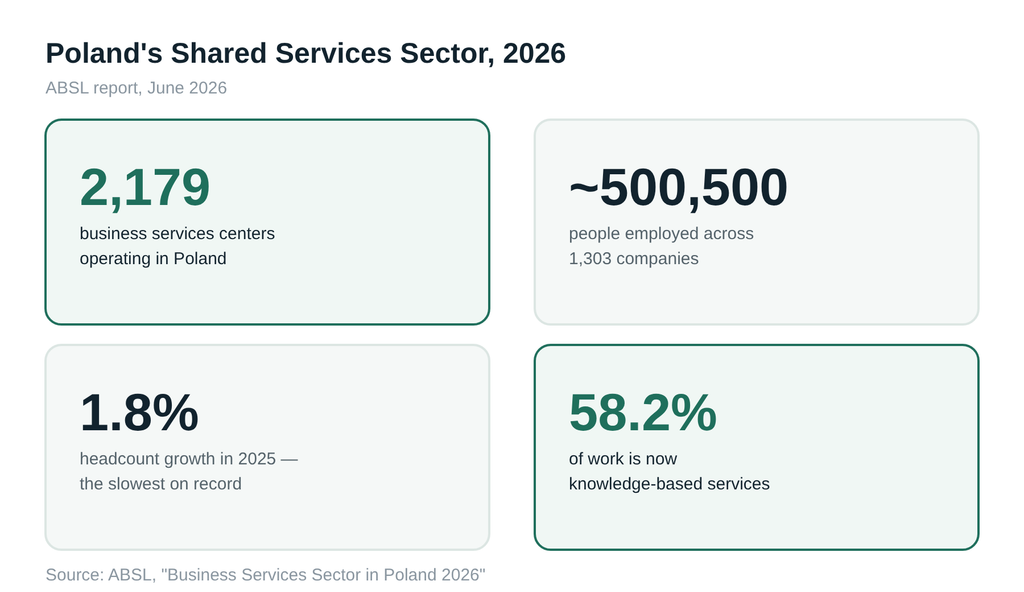
Poland’s shared services market is mature — but it isn’t an easy one to walk into. According to the ABSL report from June 2026, Poland is home to 2,179 business services centers run by 1,303 companies, employing around 500,500 people. In 2025, headcount in the sector grew by just 1.8% — the slowest pace in its history — and 58.2% of the work being done is now knowledge-based. In other words, a new center isn’t competing for graduates; it’s competing for experienced specialists against more than two thousand centers that are already there.
Below, we walk through a sample timeline for building a center from zero to roughly 200 people in an RPO model, how to calculate the number of recruiters you’ll actually need at each stage, and seven pitfalls that most often push the start date back. If you’re exploring what it takes to hire at this volume in Poland, see how we handle large-scale recruitment here.
RPO, In-House, or an Agency — Which One, and When
In a center build, RPO tends to win for two reasons: it can start working before you’ve even hired your own head of recruitment, and it scales up and down with each wave of hiring. With the RPO model, you pay a flat retainer for a team of recruiters working for you — not a commission on every single hire.
| In-house TA team | Agency (success fee) | RPO | |
|---|---|---|---|
| Time to start | 2–4 months to hire and onboard a recruiter | Immediate, but handled role by role | Recruiters ready within days; first candidate recommendations in as little as 7 days |
| How you pay | Salaries and tools, regardless of how many hires | Typically 15–25% of annual salary per hire | A flat retainer for the recruiting team |
| Scaling | Slow in both directions | Fast, but cost climbs with every hire | Team size flexes with each hiring wave |
| Works best when | The center is stable and hiring is mostly backfilling turnover | You have a handful of individual, hard-to-fill roles | You’re planning dozens of hires or more against fixed dates |
Comparison source: Recruitment Process Outsourcing — the Solution of the Future.
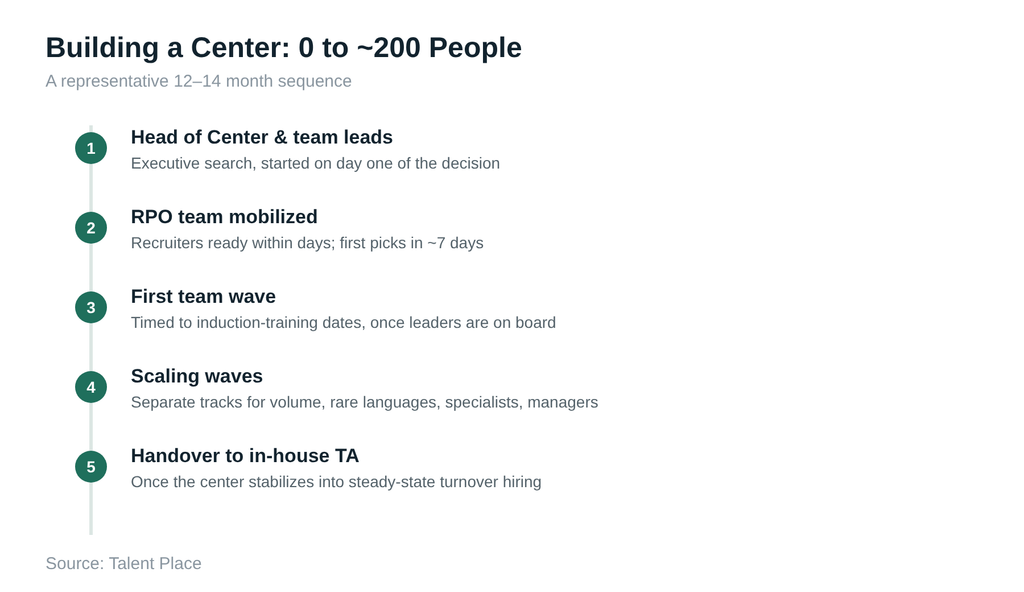
In practice, the models blend. The Head of Center and directors are usually recruited separately, through executive search, while RPO handles the volume. An in-house TA team typically takes over once the center has stabilized.
The Timeline, at a Glance
The order of the steps follows directly from the rules below: leaders first, teams in waves timed to training dates, RPO carrying the volume, handover to an in-house team at the end. In a representative project, roughly 12–14 months pass between the go-ahead decision and reaching around 200 people.
How Many Recruiters You Actually Need, at Each Stage
The number of recruiters you need is set by your single most intense month — not the project’s average. You can work it out in three steps.
- Map your headcount plan by start date, month by month. Not offer-accepted date — start date. Break it down by role, seniority, and language, because each of those groups hires at a different pace.
- Work backward from each start date by the notice period plus the hiring process itself. Under the Polish Labor Code, notice periods for an open-ended contract run two weeks for tenure under six months, one month for tenure between six months and three years, and three months for tenure of three years or more. Experienced specialists and team leads typically fall into the one-to-three-month range. On top of that comes the hiring process itself — usually up to three weeks for standard roles and up to four weeks for specialist and managerial ones, in our experience. We used the same backward-planning logic when writing about recruiting ahead of seasonal peaks rather than during them.
- Divide the month’s hiring target by one recruiter’s real throughput. Throughput depends on the role, the number of stages, and any assessments involved — so set it together with your RPO partner, based on their data from similar processes.
An example. Say you’re planning 15 hires a month for English-speaking specialist roles during the scaling phase. If one recruiter genuinely closes 3–5 such hires a month, you need 3–5 recruiters plus sourcing support. Count rare languages and management roles separately — they eat up disproportionately more time per hire.
The advantage of RPO is that the team doesn’t need to stay a fixed size. In a typical center build, it starts with 1–2 people recruiting leadership, scales up for each wave, and scales back down once hiring shifts into steady-state turnover.
7 Pitfalls That Delay a Center’s Launch
1. Leaders hired alongside their team, or after it
A team leader hired the same month as their team won’t have time to help recruit them, let alone prepare training. Experienced leaders also carry the longest notice periods of anyone you’ll hire.
How to avoid it: start recruiting the Head of Center and team leads on day one of the decision to build the center, and schedule the first team waves only after those leaders are already on board.
2. Planning around offer-accepted dates instead of start dates
An offer accepted in March, against a three-month notice period, means an employee who starts in June. On top of that, some candidates will take a counteroffer from their current employer.
How to avoid it: plan against start dates, build in a buffer for dropouts, and stay in touch with candidates throughout their entire notice period.
3. One process for every role
High-volume roles requiring English, positions needing Dutch or a Scandinavian language, and expert-level roles all draw from completely different candidate pools and move at completely different speeds. A single shared queue means your hardest roles wait the longest.
How to avoid it: run separate tracks for volume hiring, rare languages, specialists, and managers, each with its own targets and reporting.
4. A process that’s too long, with slow feedback
Four interview stages, an assessment that half the candidates fail, and a hiring manager at headquarters who takes a week to respond — that’s a recipe for losing your best candidates. If only 40% of candidates pass an assessment, your pipeline needs to be 2.5 times wider just to compensate.
How to avoid it: model your funnel before you start, trim the process down to the stages you actually need, and write feedback turnaround — 48 hours, say — into the agreement with both your partner and your hiring managers.
5. A brand nobody in Poland has heard of
A company well known in Belgium or the US can mean absolutely nothing in Kraków or any other Polish city. On top of that, as of December 24, 2025, employers in Poland must disclose salary or a pay range to candidates — in the job ad or before the interview — and can no longer ask what a candidate currently earns (source: Infor).
How to avoid it: prepare a short, concrete story for the center — which processes it’s taking over, what the career path looks like, what it pays — and sign off on the pay range before the first job ad goes live.
6. Hiring faster than the center can actually onboard people
Twenty people starting in the same week with no equipment, no system access, and no trainer is the fastest route to losing them during probation.
How to avoid it: treat onboarding capacity as your real recruiting ceiling, and schedule hiring waves around your induction-training dates.
7. No exit plan from RPO
If the candidate database, interview notes, and market knowledge all live only with your provider, handing recruiting over to your own team means starting from zero.
How to avoid it: settle in the contract whose ATS the recruiters work in, who owns the candidate database, and exactly what a handover looks like.
Checklist Before You Start an RPO Engagement
- [ ] A 12–14 month headcount plan built around start dates, broken down by role, seniority, and language
- [ ] Role profiles and salary ranges signed off before any job ad goes live
- [ ] A list of hiring managers, their availability, and an agreed feedback turnaround
- [ ] A defined hiring process: number of stages, assessments, who makes the final call
- [ ] Induction-training dates and the maximum group size per session
- [ ] An agreed ATS and clear ownership of the candidate database
- [ ] KPIs for your RPO partner: time-to-offer, offer-acceptance rate, probation-period attrition, a weekly report
- [ ] A handover plan for transferring recruiting to your own team
Frequently Asked Questions
How long does it take to build a 200-person center? In the sample timeline above, around 12–14 months from the go-ahead decision. The biggest time sink usually isn’t the hiring process itself — it’s leaders’ notice periods and how fast the center can actually onboard new people.
Does RPO pay off at just 50 people? Yes. RPO is worth considering from around 10 hires a year, and 50 hires within a few months is a typical scale at which a flat retainer comes out cheaper than paying a commission on every single hire.
Does an RPO recruiter work on-site? They can work from the center’s office or remotely. Being on-site in the first few weeks tends to make it easier to work with leaders and get to know the team early on.
Who recruits the Head of Center? Usually a separate executive search process, launched as soon as the decision to build the center is made. The new director should then have a say in hiring their own team leads.
Building a Shared Services Center?
At Talent Place, we pair dedicated RPO recruiters with a community of 400+ recruiters who reach candidates across Poland. For project44, our recruiters placed 61 specialists (see the case study). See how we approach large-scale recruitment in Poland, and let’s talk about the timeline for your center.
Sources
- ABSL, “Business Services Sector in Poland 2026” report, June 2026
- Jawność wynagrodzeń pracowników w Polsce — Infor
- Polish Labor Code, Art. 36 § 1 (notice periods for open-ended contracts)