In mid-2026, Amazon announced a billion-dollar investment in building an entire organization around a single job title. Days later, Microsoft launched a $2.5 billion business built on thousands of specialists embedded directly inside client teams to design and implement AI systems together.
That job title is Forward Deployed Engineer — the first of several genuinely new roles that artificial intelligence is now pushing into corporate org charts.
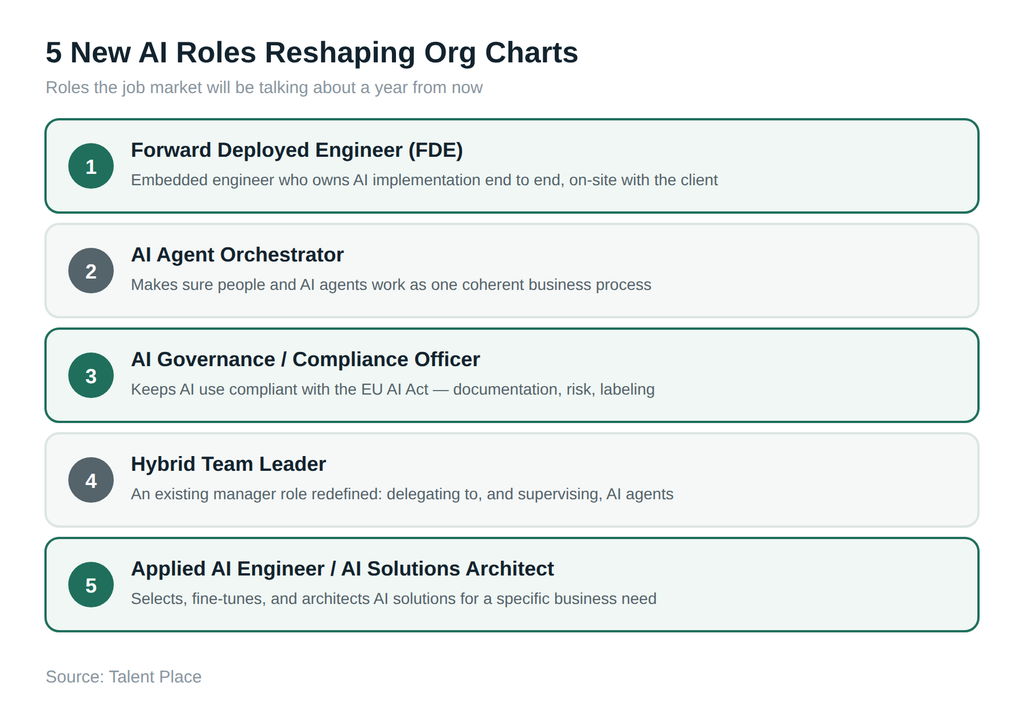
1. Forward Deployed Engineer (FDE)
The role itself isn’t new — it originated over a decade ago at Palantir, which embedded top engineers directly with government agencies and large enterprises to implement and customize its systems on-site. What’s new is how quickly the biggest players in AI — OpenAI, Anthropic, and well-funded startups alike — are now copying that model.
An FDE operates less like a typical developer working through a backlog and more like a founding engineer on someone else’s product. They’re handed a client, a specific problem, and a deadline, and then own the implementation end to end.
Why this role has exploded now: the standard SaaS playbook doesn’t really work for AI. Every enterprise brings its own data, its own processes, and its own compliance requirements — selling AI into a large company usually means selling the entire integration project along with it.
FDE demands a rare combination of skills: engineering depth, industry knowledge, and the ability to manage relationships at the executive level. Demand is enormous, but the pool of people who can genuinely do all three remains very small — which makes it one of the hardest roles in tech to fill right now.
2. AI Agent Orchestrator
Gartner named multi-agent systems a top strategic priority for enterprises in 2026. But companies actually rolling out AI agents keep running into the same pattern: agents are good at individual tasks, and bad at coordinating work — whether with humans or with each other.
That’s the gap the AI Agent Orchestrator fills. Rather than building yet more agents, this role makes sure the whole “fleet” — people and autonomous systems together — functions as one coherent, manageable business process, instead of a pile of tools each running on their own.
Organizational maturity around AI-driven workflows is still fairly low across the board, which suggests demand for this role is about to pick up fast.
3. AI Governance / Compliance Officer
Unlike the first two roles, which grew out of the technology itself, this one exists because of regulation. The EU AI Act is now moving into new compliance phases — from obligations for general-purpose model providers to full requirements for high-risk systems, including AI used in hiring and credit decisions.
The AI Governance Officer’s job is to make sure an organization’s use of AI actually complies with the rules — documenting how systems work, running risk assessments, and monitoring whether AI-generated content is being labeled the way regulation now requires.
The role needs an unusual mix of skills: a real technical understanding of how models work, paired with deep regulatory expertise. Financial services, HR, and healthcare will need these specialists soonest, since the consequences of non-compliance are steepest there. It’s a related but distinct question from which HR roles AI itself is reshaping — governance is a new function being built up, not an old one being automated away.
4. Hybrid Team Leader
The fourth shift isn’t a new job title — it’s an existing managerial role being redefined. A growing number of managers are now running hybrid teams: people and autonomous agents that handle entire segments of a business process, not just people alone.
The generational gap here is already visible: management consistently reports being far more comfortable with AI-agent concepts than frontline employees are, and most leaders believe AI will accelerate their careers rather than threaten them.
The core managerial skill in this model is shifting — from “prompting” to actually delegating work to autonomous systems and supervising their output the way you’d supervise a person’s. It’s the same competency gap we’ve flagged before, and it’s one most managers simply haven’t built yet. Companies that ignore it risk a different kind of bottleneck on AI adoption: not the technology, but the management of it.
5. Applied AI Engineer / AI Solutions Architect
This last role sits somewhere between a classic data scientist and a Forward Deployed Engineer. The Applied AI Engineer selects, fine-tunes, and architects AI solutions for a specific business need — without necessarily living inside the client’s team long-term the way an FDE does.
The market numbers show the scale of demand: job postings requiring AI or machine-learning skills have surged within a single year, and now account for more than half of all tech-sector postings. For a lot of companies, this role is the practical middle ground — a way to build real AI capability in-house without competing for the market’s most expensive FDE salaries. The hiring challenge looks a lot like what we’ve seen recruiting for prompt engineer roles: the job title moved faster than the market’s ability to agree on what it actually means.
What This Means for HR and Recruitment Right Now
None of these five roles have a standardized job description or an established career path yet — companies have to define them on their own, while watching how the market evolves. But all five share one thing in common: “boundary-spanning” skills — combining technical depth, business context, and the ability to communicate with clients or executives — matter more here than narrow specialization ever did.
Because there’s no standard CV for any of this yet, “AI” on a resume isn’t enough to verify anything on its own. What matters in an interview is concrete questions about how someone actually worked, not a list of buzzwords — the same verification discipline we lay out in how to check whether a candidate really works with AI.
Competition for these profiles is global, not local. A Polish company hiring for one of these roles isn’t just competing with the domestic market — it’s competing with organizations abroad offering salaries well above what’s typical here. That’s a strong argument for building these competencies in-house sooner rather than later, before wage pressure pushes the cost even higher.
Checklist: 4 Questions Before You Open a Search for an AI Role
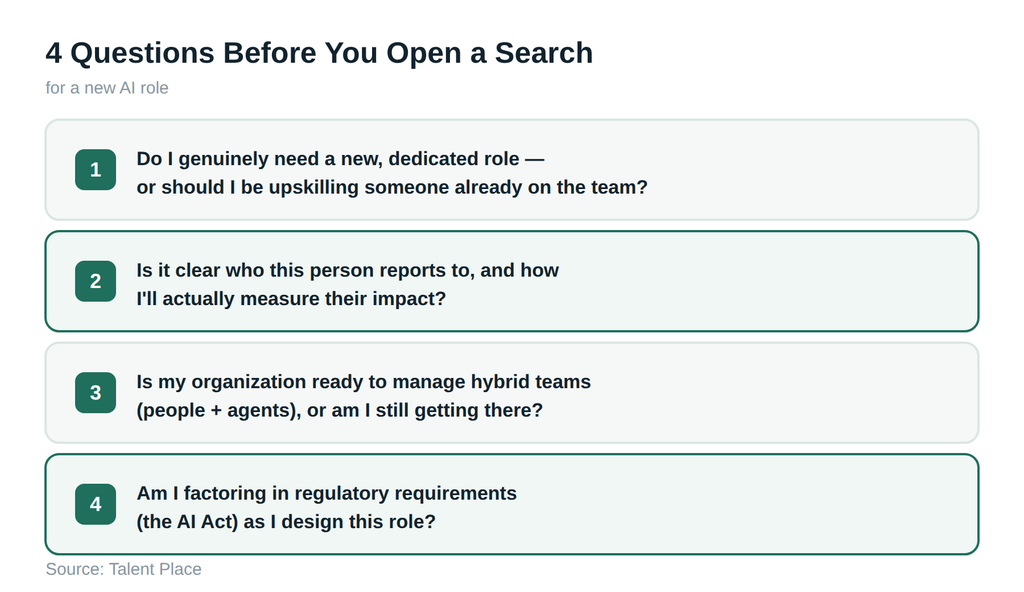
- Do I genuinely need a new, dedicated role — or should I be upskilling someone already on the team?
- Is it clear who this person reports to, and how I’ll actually measure their impact?
- Is my organization ready to manage hybrid teams (people + agents), or am I still getting there?
- Am I factoring in regulatory requirements (the AI Act) as I design this role?
Building out an AI-focused team and not sure what to even call the role you’re looking for? Talent Place tracks how these roles at the intersection of technology and business are evolving, and helps companies define competency profiles before they become market standard — including through our work placing AI specialists in Poland. Get in touch and let’s talk about your team.
Sources: TechCrunch, “Forward-deployed engineers are the AI industry’s latest talent obsession” (July 2026); Gartner, “Top Strategic Technology Trends for 2026”; industry reports on AI implementation maturity and agent adoption in organizations, 2026.