Companies growing their sales team face a choice they may not even realize they’re making: hire salespeople who occasionally open ChatGPT, or deliberately build an AI-native sales team — one where AI is woven into daily work rather than bolted on as an extra tool.
The gap between these two approaches has widened significantly, and it’s starting to show up directly in sales results.
The Scale of the Shift
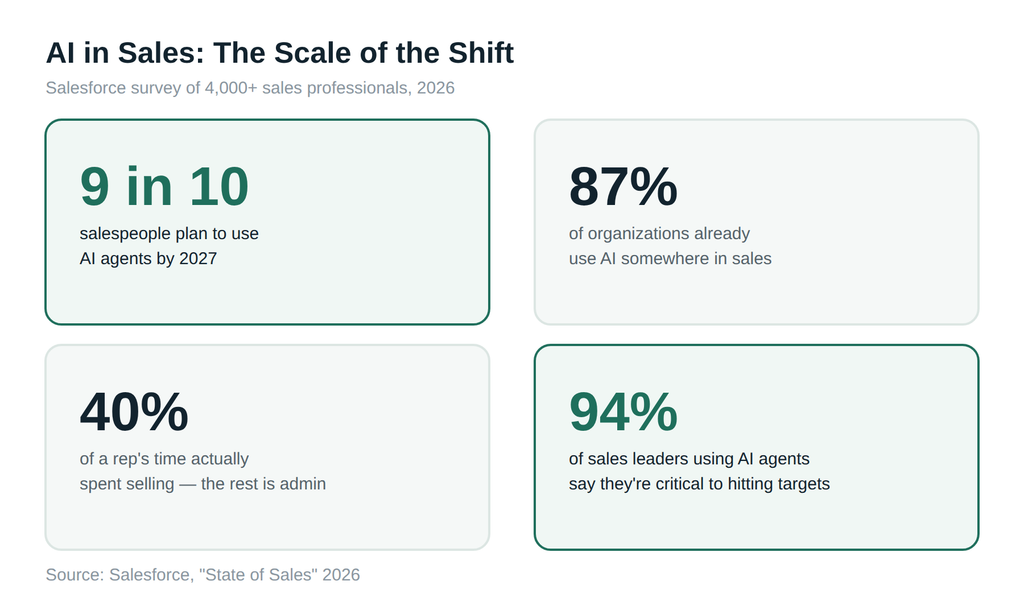
Salesforce surveyed more than 4,000 sales professionals and found that 9 in 10 salespeople plan to be using AI agents by 2027. Today, 87% of organizations already use AI somewhere in sales, and 54% have agents running as part of routine work.
Reps spend only about 40% of their time actually selling — talking to clients, building relationships, negotiating. The rest goes to administration: updating the CRM, drafting proposals, manually researching leads. The impact on results is already visible at the leadership level: 94% of sales leaders using AI agents say they’re critical to hitting the team’s targets.
Younger reps, Gen Z in particular, feel this administrative load the hardest — and are the quickest to embrace AI as a way to claw back time for the parts of the job that actually generate revenue.
What Actually Separates an AI-Native Salesperson From an Occasional User
Occasional AI users reach for these tools now and then — drafting an email, summarizing notes from a call. Everything else in the sales process stays exactly as it was: leads sourced by hand, qualified by hand, analyzed by hand.
AI-native salespeople have AI built into the workflow itself, including things like:
- Lead qualification handled automatically, using CRM data and interaction history
- Battle cards generated from analysis of past sales conversations, with ready answers to the objections that come up most often
- Real-time alerts when a competitor gets mentioned, or when the same customer question keeps coming up
- CRM records that update themselves after a call, instead of being typed in by hand afterward
None of this replaces the salesperson — it takes the tedious administrative work off their plate so they have more time for the conversations, relationships, and negotiations that actually close deals. The distinction is the same one we draw for any AI-driven role: AI-aware versus AI-native, and how to actually tell the difference.
How This Is Changing What Recruiters Look For
The core sales competencies — relationship-building, negotiation, understanding what a client actually needs — haven’t gone anywhere. What’s new is that working with AI tools has become part of the job itself, not a bullet point tacked on at the bottom of a CV.
There’s an important caveat worth flagging here: analyses of AI rollouts in sales consistently show a clear, positive return only in teams of at least three people that already have an organized database to work from. In practice, that means hiring for AI-native sales only really pays off where a company already has — or is deliberately building — the data infrastructure to support it.
The best way to check for the real thing in an interview isn’t to ask “do you use AI?” — it’s to ask a candidate to walk through what their actual day-to-day workflow with these tools looks like, the same verification discipline we lay out in how to check whether a candidate really works with AI.
The Most Common Mistakes When Building an AI-Native Sales Team
Hiring on the strength of a claim, not a demonstration. Candidates say they “use AI” in interviews, but in practice that often means one tool, used occasionally. Companies end up paying a premium for a skill set the person doesn’t actually have — a real cost on top of what it already takes to hire a salesperson in the first place.
Rolling out AI on top of messy data. Deploying agents into a team with a chaotic lead database and inconsistent CRM habits disappoints no matter how good the candidates are — these tools are only ever as good as the data underneath them.
Treating AI as a replacement instead of support. This sets expectations no one can meet, and it demoralizes a team that starts to feel like it’s being measured against an impossible bar.
Two Paths to Getting There
Path 1: Build an AI-native team internally, from where you are today. This takes time — a deliberate hiring process and a concrete implementation plan — especially when sales growth is outpacing how fast the existing team can adapt to new ways of working.
Path 2: Hire salespeople who are already operating this way. Faster, but it only works if HR (or your recruiting partner) can actually tell the difference between real capability and a well-worded CV. Without that ability, you end up comparing candidates on price and years of experience instead of on the value they’d actually bring — which is also why sourcing AI-native talent takes more than a LinkedIn search.
Five Signs Your Sales Team Isn’t AI-Native Yet
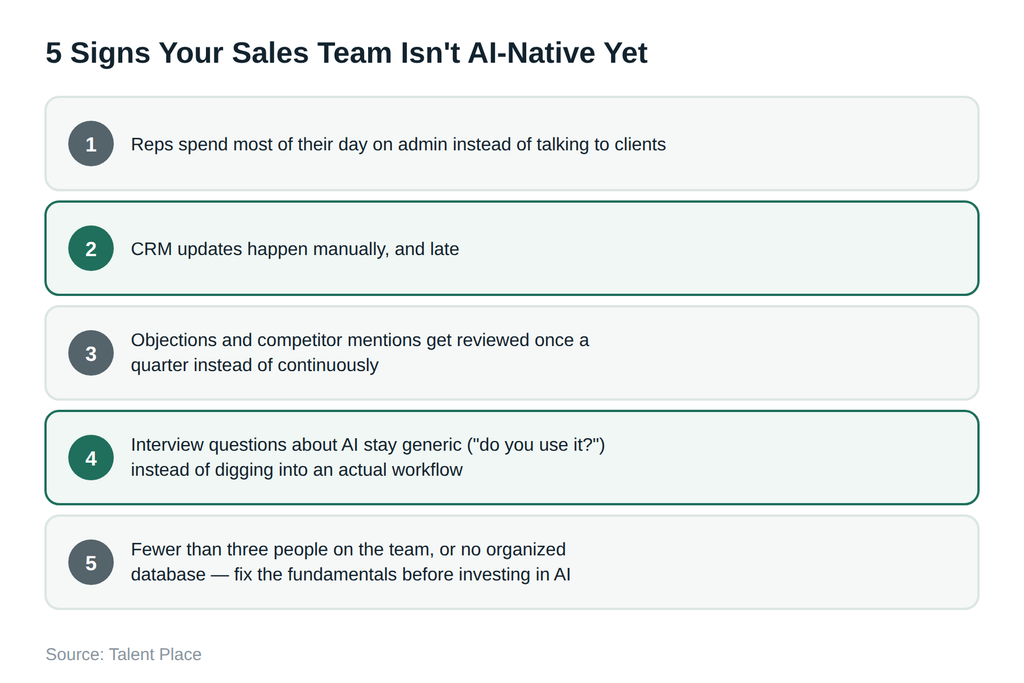
- Reps spend most of their day on admin instead of talking to clients.
- CRM updates happen manually, and late.
- Sales conversations — objections, competitor mentions — get reviewed once a quarter instead of continuously.
- Your interview questions about AI stay generic (“do you use it?”) instead of digging into an actual workflow.
- Your team has fewer than three people, or no organized database — in which case, fix the fundamentals before investing in AI at all.
Building a sales team for the AI-native era and not sure where your current team actually stands? At Talent Place, we take the same approach to sales recruitment that we’d recommend for evaluating AI-native skills in general — checking real workflows, not just what’s written on a CV. Get in touch and let’s talk about where your team is headed.