A manufacturing company posts an ad for a maintenance technician. Job board, a solid job description, a standard hiring process. Three weeks later? A handful of applications, none of them a fit. The problem isn’t that these specialists don’t exist. It’s that the company is looking for them in the wrong place, in the wrong language, at the wrong speed.
That’s daily life when hiring so-called grey collars — workers who don’t fit neatly into “desk job” or “shop floor,” but sit somewhere in between. This article covers who they actually are, why they’re one of the most under-supplied segments of the labor market right now, what they cost to hire, and how to actually reach them.
1. Who Grey Collars Are — And How They Differ From Blue Collar
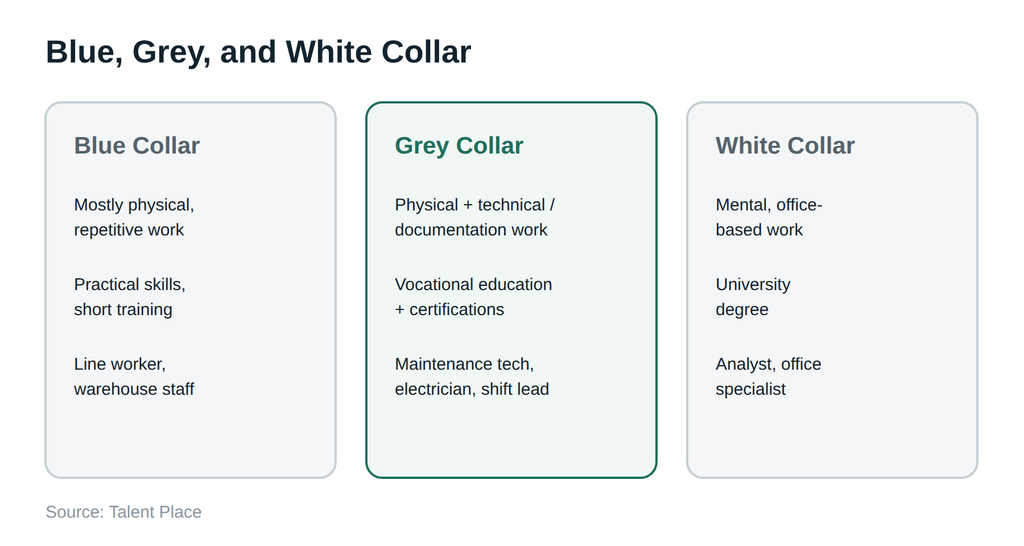
Grey collar workers combine physical work with technical knowledge, documentation, and, increasingly, digital skills. They’re the people who have to “think and use their hands” at the same time: diagnose a fault, run an advanced machine, handle technical documentation, or lead a small team on the shop floor.
Typical roles in this category:
- Maintenance technician
- Industrial electrician / automation specialist
- CNC machine operator
- Shift supervisor / production team lead
- Automotive diagnostics technician
| Blue Collar | Grey Collar | White Collar | |
|---|---|---|---|
| Nature of work | Mostly physical, repetitive | Physical + technical/documentation | Mental, office-based |
| Required qualifications | Practical, short training | Vocational education + certifications | University degree |
| Example roles | Line worker, warehouse staff | Maintenance tech, industrial electrician, shift lead | Analyst, office specialist |
2. Why Demand Is Outgrowing Supply
Automation and robotics don’t eliminate these roles — they change them. The machines replacing physical labor still need people to commission, diagnose, and repair them. That’s exactly the grey collar profile. You see it clearly in sectors with the strictest quality standards: in defense-sector recruitment, CNC operators, electricians, and maintenance technicians are just as hard to find as engineers — even though they rarely get thought of in the same category.
Poland’s annual Occupational Barometer — a forecast published by the Ministry of Family, Labour and Social Policy — confirms this directly. In the 2026 edition, electricians and power engineers landed on the nationwide shortage list again, alongside roles like construction installation technicians and earthmoving equipment operators. The total number of shortage occupations nationwide actually fell this year, to 17 out of 168 professions analyzed (down from 23 the year before) — but technical and maintenance roles remain some of the hardest to fill, with electricians even landing in the “severe shortage” category in several regions.
This isn’t a temporary trend. Rising quality standards in automotive, pharma, and food manufacturing mean companies aren’t just looking for “an extra pair of hands” anymore — they need people who understand process, documentation, and technology all at once. And the education system is producing them more slowly than demand is growing.
3. Why Standard Recruitment Fails Here
- These candidates rarely job-hunt actively. They tend to have a stable position, real experience, and usually a job already — they move mainly through referrals and industry contacts, not by browsing job boards.
- They have no patience for long, bureaucratic processes. A multi-stage process with tests and several rounds of interviews — standard for white-collar roles — is a turn-off for this group.
- A vague job ad gets ignored immediately. No salary range, no shift pattern, no mention of the specific equipment or certifications required — that’s a signal the company doesn’t actually know who it’s looking for.
- The result: the role sits open for weeks, and the company concludes “there’s nobody out there” — when the real problem is the outreach method, not candidate availability. It’s one of the main reasons it’s worth thinking through when external recruitment actually makes sense — especially for production and technical roles, where internal HR rarely has a ready-made network.
4. How to Actually Reach Grey Collar Candidates
Referrals and industry networks outperform job boards. In this professional group, a colleague’s word carries more weight than the best-written ad.
Actively sourcing passive candidates. The best technicians and industrial electricians aren’t job-hunting — you have to reach them before they start. This is exactly where a model built on a broad recruiter community and standing candidate databases — talent pooling and crowdstaffing — clearly outperforms a one-off job posting.
Specifics in the messaging. Salary range, shift system, the actual machines or tools involved, a development path — this group values clarity far more than branded language about “company culture.”
Speed of process. Cutting the number of stages and giving fast feedback measurably improves results — this candidate group usually has more than one offer on the table.
5. What Grey Collar Recruitment Costs in 2026
The figures below come from Poland’s National Salary Survey (wynagrodzenia.pl, Sedlak & Sedlak), current as of 2026 — one consistent source makes for a fair comparison across roles.
| Role | Median (gross) | Range (middle 50%) |
|---|---|---|
| CNC Operator | 7,340 PLN | 6,400–8,450 PLN |
| Production Shift Supervisor | 7,500 PLN | 6,360–8,920 PLN |
| Maintenance Technician | 8,070 PLN | 7,200–9,630 PLN |
| Industrial Electrician | 8,130 PLN | 7,090–9,470 PLN |
For comparison: that’s on par with, or above, the median salary for plenty of mid-level office roles — a useful argument when talking to a board that still sees these roles as “cheaper” than white-collar work.
An empty seat often costs more than the salary itself. An unfilled maintenance technician or industrial electrician role isn’t just a longer, costlier search — it’s real risk of production downtime, delays, and losses that, in manufacturing, run into the thousands per day of delay. That sets this group of roles apart from most office jobs, where one missing person rarely stops the whole line. The hidden-cost mechanism here is similar to what actually goes into the cost of hiring through an agency — the headline salary figure is only the starting point of the real math.
6. Checklist: 6 Signs Your Company Is Getting Grey Collar Recruitment Wrong
- Job ads sit open for weeks with no serious applications.
- The ad has no salary range and no technical specifics.
- The full hiring process takes longer than two weeks.
- The company has no referral base or contacts in that professional community.
- Turnover on these roles is high because competitors poach with faster, better offers.
- HR runs recruitment for these roles exactly the same way it runs recruitment for office roles.
If you recognize your company in at least two of these, it’s a sign to change approach before the next open role starts generating real operational cost.
Looking for maintenance technicians, industrial electricians, CNC operators, or shift supervisors, and standard job ads aren’t delivering? At Talent Place, we reach candidates who aren’t actively job-hunting through a community of more than 400 professional recruiters and a talent pooling model. Get in touch and let’s talk about your recruiting need.