Your company just grew from 20 to 80 people. The one HR person who used to handle everything is drowning — open reqs are piling up, paperwork is falling behind, and leadership keeps asking why “the HR department” never has bandwidth for anything strategic. Someone finally asks the obvious question: who do we hire next? Another generalist? A dedicated payroll person? Or one of those HR Business Partners everyone keeps talking about? And honestly, this is exactly the moment to ask a bigger question too — whether your whole talent acquisition function is structured to keep up with growth, not just this one hire.
The trouble is, these three roles get mixed up constantly — and not just at the coffee machine. They get mixed up in the job postings themselves. The result: companies hire the wrong profile for the wrong stage, either overpaying for skills they don’t need yet, or underinvesting exactly where it costs them the most.
In this piece, we break down Payroll, HR Generalist, and HR Business Partner: what actually separates them, when each one earns its keep, what it costs to hire one in 2026, and the mistakes that trip companies up along the way.
1. Three Roles, One Department — What Actually Separates Them
| Payroll Specialist | HR Generalist | HR Business Partner | |
|---|---|---|---|
| Median salary (2026) | $58,000 | $72,000 | $88,000 |
| Typical range | $47,000–$74,000 | $57,000–$86,000 | $72,000–$103,000 |
| Core focus | Processing pay, tax withholding and filings, wage/hour compliance, benefits administration | Full operational HR: recruiting, onboarding, policy and process, day-to-day employee support | Advising leadership and managers, supporting business decisions, leading organizational change |
| Works mainly with | Finance/accounting, the IRS, Social Security Administration, state unemployment offices | The whole company, candidates, line managers | Executive leadership, department heads, team leads |
| Typical seniority | Junior–Mid | Mid | Mid–Senior |
| When it typically shows up | When headcount and worker classifications (W-2, 1099, part-time) grow enough that manual payroll becomes a real risk | When a company has roughly 20–100 employees and needs one person to own HR end-to-end | When a company crosses ~100 employees, or when HR needs to actually shape business strategy, not just administer it |
Sources: 2026 compensation data aggregated from ZipRecruiter, Salary.com, Glassdoor, and PayScale. Median means the midpoint — half of people in the role earn less, half earn more.
The gap between the medians tells its own story: an HR Business Partner earns roughly 20–25% more than a Generalist, and about 50% more than a Payroll Specialist. That’s not arbitrary — scope of responsibility and influence over business decisions both climb sharply at each level. Before you spring for the pricier role, it’s worth checking whether your organization is actually at a stage that needs it.
2. How to Tell Who You Actually Need
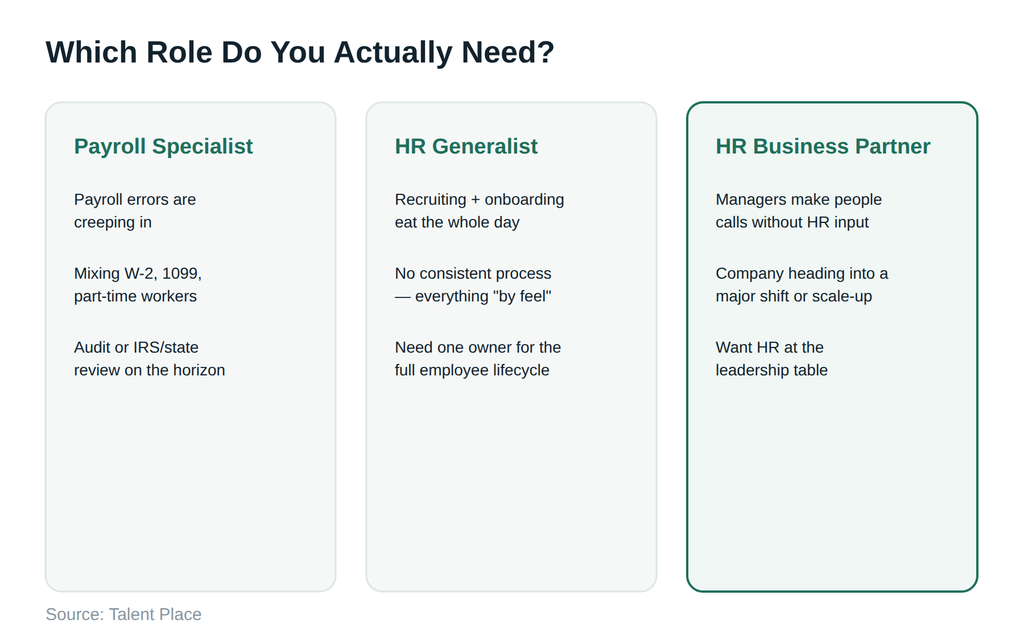
You need a Payroll Specialist when:
- Running payroll eats up more and more time, and mistakes are creeping in;
- You’re mixing worker types — W-2 employees, 1099 contractors, part-time staff — and the risk of misclassifying someone keeps growing;
- A wage-and-hour audit or IRS/state review is on the horizon and your records aren’t fully in order.
(If that last one sounds familiar, worker misclassification is a genuinely costly mistake to make — it’s worth having a dedicated payroll hire review your W-2/1099 mix before an audit forces the issue, not after.)
You need an HR Generalist when:
- Recruiting, onboarding, and general firefighting are consuming one person’s entire day;
- There’s no consistent process — PTO, performance reviews, offboarding all run “by feel” instead of by a defined workflow;
- You need someone who can own the full employee lifecycle, but you’re not yet big enough to split that across several specialists.
You need an HR Business Partner when:
- Managers are making people decisions — firings, promotions, reorgs — without HR input, and it’s creating risk and conflict;
- The company is heading into a major shift — scaling, restructuring, a new way of working — and needs someone to lead the human side of it;
- You want HR to be a genuine partner in leadership conversations, not just an administrative back office.
3. The Most Common Hiring Mistakes in HR
Posting “HR Generalist” with an HRBP job description (or the reverse). This is one of the most common mistakes we see in recruiting projects. A company needs someone for day-to-day HR operations but writes the posting around “strategic advisory to leadership” — or the reverse, advertising a business-partner role with generalist-level duties. The result: the wrong candidates either don’t apply at all, or wash out at the first interview.
No clarity on reporting lines. Does the HRBP report to the CEO, to a VP of People, or to a specific business unit leader? Not answering that before the search even starts is a fast track to frustration in the new hire’s first few weeks.
Hiring an HRBP before you’re ready. A company without basic HR processes in place hires an expensive Business Partner, hoping they’ll “just figure it out.” The usual result is the opposite — instead of advising leadership, the HRBP ends up firefighting operational issues they’re overqualified (and overpaid) to handle.
Treating payroll as a side task for HR. In small companies, it’s often the Generalist who handles payroll “on the side.” That works fine while the company is small — but as headcount grows, so does the risk of costly mistakes with tax withholding and benefits.
4. Pay Transparency Is Already Here — And It’s Rewriting How You Hire
This isn’t a future problem — it’s already reshaping how every HR team in the country writes job postings. There’s no single federal pay-transparency law yet, but the state-level patchwork has grown fast: as of 2026, more than a dozen states plus Washington, D.C. — including California, Colorado, New York, Illinois, Washington, and Massachusetts — require employers to disclose a good-faith salary range in job postings, and several more (Virginia, Maine, Connecticut) added or tightened requirements just this year. Penalties range from a few hundred dollars to as much as $250,000 per violation depending on the jurisdiction.
The catch for remote-friendly companies: if a role can be filled by someone sitting in a pay-transparency state, that state’s law usually applies — regardless of where your company is headquartered. In practice, almost nobody gets to skip this anymore.
Some states go further still. California, for example, requires employers with 100 or more employees to file an annual pay-data report breaking down compensation by job category, race, and gender. That means your payroll and HR data need to be clean, consistent, and easy to analyze — a job that lands squarely on Payroll and HRBP, since they’re the ones who own compensation strategy.
For companies still planning to grow their HR team, that’s one more reason to do it proactively — not in a scramble once an audit or a compliance complaint forces the issue.
5. What It Actually Costs to Hire in 2026
Beyond base salary, you need to account for the fully loaded cost of employment — employer-side payroll taxes (Social Security and Medicare under FICA, plus federal and state unemployment insurance) and mandatory costs like workers’ compensation. In the U.S., that typically adds roughly 25–30% on top of base salary — and that’s before health insurance, retirement matching, and other benefits, which tend to push the real number even higher than in many other countries.
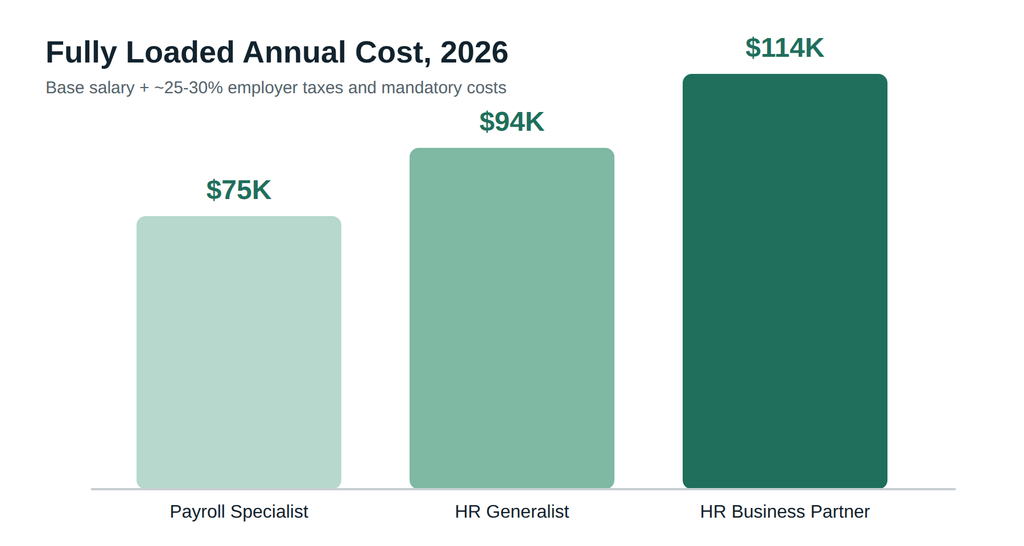
Approximate fully loaded annual cost, based on 2026 medians:
- Payroll Specialist: ~$75,000/year (base $58,000 × ~1.3)
- HR Generalist: ~$94,000/year
- HR Business Partner: ~$114,000/year
On top of that, factor in the cost of the search itself — internal recruiter time, job board spend, and for harder-to-fill roles (especially HRBP), possibly a recruiting agency. As we cover in our guide to choosing a recruitment agency, agency pricing structures vary a lot more than the headline fee suggests — the math holds up the same way for HR roles.
The real cost of a bad hire, though, is steeper than it looks. If someone leaves within a few months — because the job never matched the posting, or their skills didn’t fit what the company actually needed — you’re on the hook for: the salary already paid, a second full search, the manager’s time lost to onboarding, and months of a half-staffed HR function. In practice, that can add up to several months’ worth of salary — a solid argument for getting the role definition right before the posting goes live.
6. Full-Time Hire or a Flexible Model?
Not every company needs a full-time HRBP — and not every company can justify one yet.
A full-time hire makes sense when:
- The need is stable and long-term;
- Your company is large enough that one person will be fully utilized;
- You want someone who builds lasting relationships with the team and with leadership.
A flexible model — a fractional or contract HRBP — makes sense when:
- The need is temporary: a restructuring, a new process rollout, a major hiring push;
- You’re not ready for the cost of a full-time role but need strategic HR support right now;
- You want to test how the role performs in your organization before committing to a permanent hire.
At Talent Place, we help companies figure out the right model — from a full permanent search, to project-based support, to a fractional HRBP engagement. If you’re weighing which approach fits your situation, we’re happy to talk it through.
7. Checklist: 7 Questions to Ask Before You Open the Search
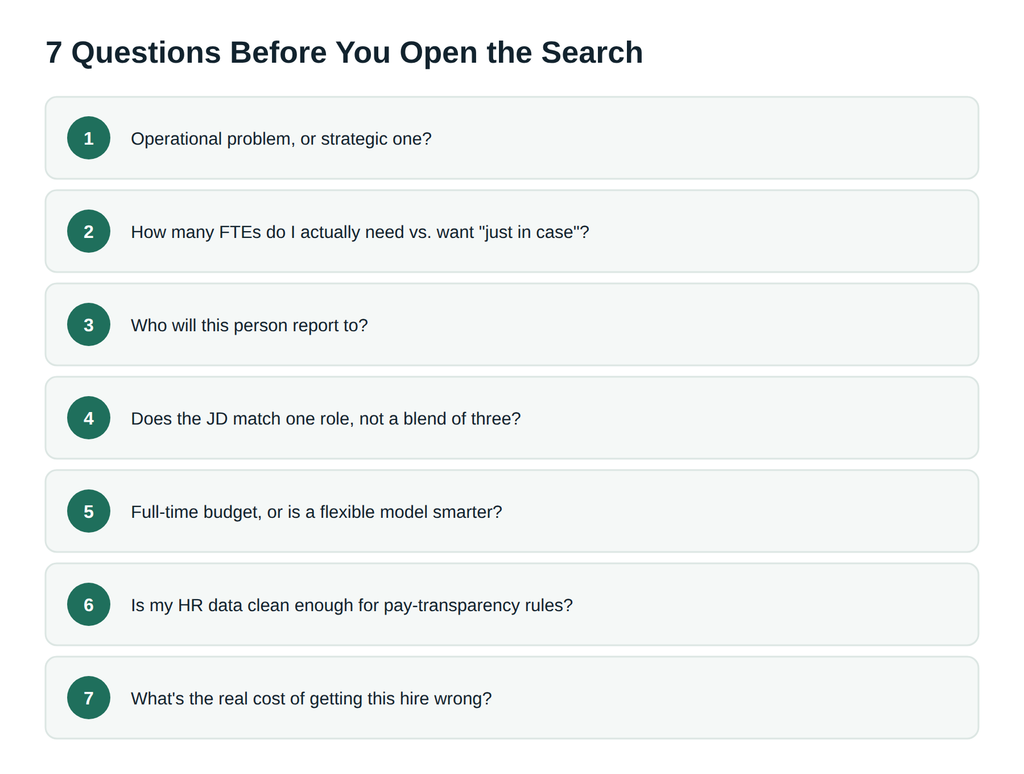
Before you publish a posting, it’s worth answering:
- Is the problem I’m solving operational (day-to-day support) or strategic (business decision-making)?
- How many FTEs do I actually need — versus how many I want “just in case”?
- Who will this person report to, and is that clear to everyone in the organization?
- Does the job description I’ve drafted actually match one role — not a blend of three different jobs?
- Do I have budget for a full-time hire, or is a flexible model the smarter starting point?
- Is my payroll and HR data clean enough to meet upcoming pay-transparency and reporting requirements?
- What’s the real cost of getting this hire wrong — and can I afford to run the search again in a few months?
Need help hiring for your HR team — whether that’s a Payroll Specialist, an HR Generalist, or an HR Business Partner? Get in touch — we’ll help you land on the right profile and the right working model for where your company is right now.