More and more HR teams are testing AI in recruitment. The problem is that AI tools alone rarely solve the hardest part of recruitment: finding the right candidates, evaluating them against consistent criteria, and deciding quickly who is actually worth contacting.
That is where AI sourcing becomes useful.
In this guide, we explain how to approach AI sourcing step by step: from preparing the sourcing brief and mapping the market to prioritizing profiles, personalizing outreach, measuring results, and deciding whether to build the process internally or use an AI sourcing service.
What Is AI Sourcing? Definition
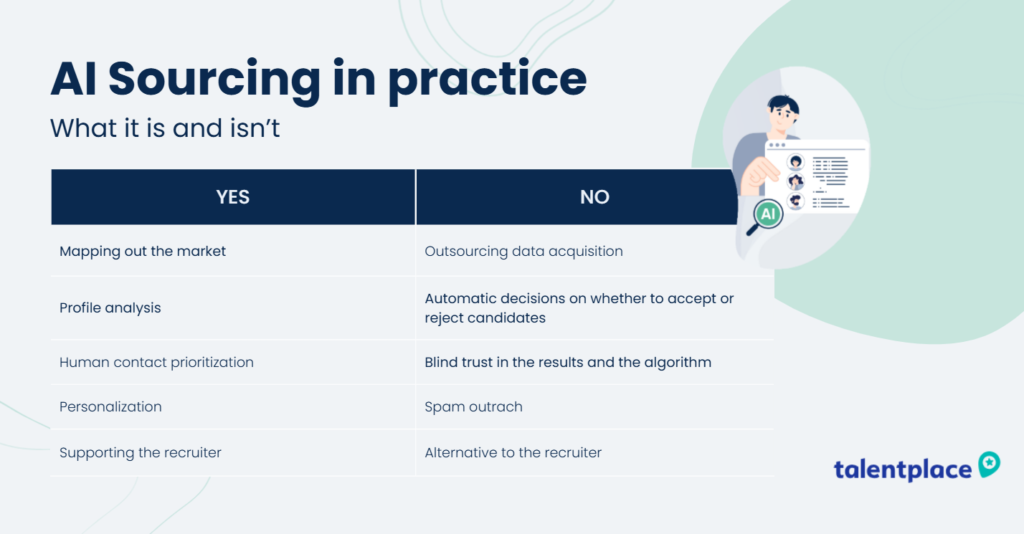
AI sourcing is the use of artificial intelligence to support the process of finding, analyzing, prioritizing, and contacting potential candidates.
AI sourcing can support tasks such as analyzing job descriptions and role requirements, creating sourcing queries, finding similar candidate profiles, comparing and segmenting those profiles into organized longlists, and identifying which profiles should be reviewed first.
But AI sourcing is not simply about automating search. Its real value comes from helping recruiters work with more data in a more structured way. A well-designed AI sourcing process helps recruiters answer important questions faster:
- Where are the right candidates likely to be found?
- Which signals in a profile suggest strong fit?
- Which profiles should be reviewed first?
- How should we contact candidates in a relevant way?
- Which sources and criteria work best for this role?
How Does AI-Powered Candidate Sourcing Work?
AI sourcing works best when it combines three elements: data, process, and recruiter judgment.
Without data, AI has nothing meaningful to analyze. Without a well-organized process, it can generate inconsistent or random results. And without a recruiter, it can, well, very easily mistake keyword similarity for real candidate fit.
That last bit is important, because AI in recruitment is often confused with automated screening or automatic candidate rejection. In a well-designed AI sourcing process, technology supports decision-making, but it does not replace human evaluation. The role of AI is to help people work better, but it should not take responsibility for judging people.
Read also: AI in Recruitment: Where It Helps & Where Recruiters Get Burned
Why an AI Tool Alone Is Not Enough
Many companies start using AI in recruitment by choosing a tool. They buy a sourcing platform, test generative AI, activate AI features in their ATS, or ask recruiters to start using prompts. At first, the results may look promising, but after a while, many teams discover that they have more data, not necessarily more relevant conversations.
That is because buying an AI tool is not the same as building an AI sourcing process.
Recruitment process is exactly that, a process. AI will work well when it supports recruitment that is already structured enough to guide it; it won’t fix an unclear recruitment brief, poorly defined must-have and nice-to-have criteria, or inconsistent scoring rules.
That’s why it’s so important for a company that wants to implement AI sourcing to do it in the right way.
Read also: Why AI Recruitment Automation Needs Orchestration
How to Implement AI Sourcing Step by Step
Step 1: Prepare a Sourcing Brief
A sourcing brief is the thing that translates business requirements into specific signals that can be identified in a candidate profile, CV, work history, or previous projects. People can derive that context by reasoning, but AI cannot.
A simple practical rule is this: before using AI for sourcing, make sure you can clearly explain who you are looking for and why that person should want to talk to you.
AI can help find candidates, but it cannot fix a weak value proposition.
Step 2: Turn Requirements into Fit Signals
AI works best with specific data. It works less effectively with broad expectations that different people may interpret differently. Instead of putting vague requirements into a tool, it is better to turn them into sourcing signals.
Example:
| General requirement | Sourcing signal |
| “B2B sales experience” | The candidate has sold to business clients, worked with a pipeline, communicated with decision-makers, and operated in a longer sales cycle. |
| “SaaS knowledge” | The candidate has sold or implemented a subscription product, worked with recurring revenue clients, or understands metrics such as churn, ARR, or MRR. |
| “Management experience” | The candidate has managed a team and been responsible for results, hiring, onboarding, or people development. |
| “Good understanding of HR processes” | The candidate has managed specific HR processes such as recruitment, onboarding, performance review, employer branding, talent management, or HR operations. |
This approach helps AI understand context: company type, scope of responsibility, seniority level, and similarity of experience. It also reduces the risk that the tool will search only for matching keywords.
Step 3: Define Scoring Before You Start Sourcing
One of the most common sourcing mistakes is evaluating candidates only after profiles have already been collected. When this happens, criteria often start shifting during the process. Each recruiter or hiring manager may interpret fit differently.
The goal is not to let AI automatically decide who is a good candidate. The goal is to help prioritize profiles and discuss them using the same logic.
That is why it is useful to define a simple scoring model before sourcing begins.
Example:
| Criterion | Weight | What do we evaluate? |
| Experience in a similar role | 30% | Has the candidate performed similar tasks and had a similar scope of responsibility? |
| Industry or product fit | 20% | Has the candidate worked in a similar environment, business model, or type of organization? |
| Technical or functional skills | 25% | Does the candidate have the required tools, technologies, processes, or ways of working? |
| Market fit | 15% | Do location, work model, salary level, and availability match the role? |
| Additional fit signals | 10% | Does the candidate have relevant certifications, languages, projects, international experience, or other useful indicators? |
The most important part of scoring is not the score itself. A good scoring model should answer one question clearly: why is this profile worth reviewing? If AI gives a candidate a high score but cannot explain the basis for that score, the result should not be treated as reliable.
Step 4: Search Across Multiple Sources Always Using One Logic
Candidates are rarely found in one place. Some are on LinkedIn. Some are already in the ATS. Some appear in external databases. Others may be found in previous recruitment projects, referrals, or recruiter networks.
When every source is handled separately, the process becomes hard to compare. The quality of results depends too much on the person currently running the search. AI sourcing should work differently.
Candidates from different sources should be compared using the same criteria: experience, skills, seniority, market fit, and potential gaps. This helps prevent the longlist from becoming a random collection of profiles from different channels.
At Talent Place, this approach is supported by our proprietary AI Orchestrator, which helps organize sourcing and data work.
Step 5: Calibrate Results with the Hiring Manager
The first longlist should be treated as material for calibration. AI cannot replace a conversation about what a “good candidate” really means for a specific role, and even the best sourcing brief may need adjustment after the first real profiles are reviewed. The hiring manager may notice that some criteria are too broad, too narrow, or that some candidates look good only at the keyword level. Only after this calibration does it make sense to scale sourcing and outreach.
A good starting point is to show the hiring manager a sample of 10–20 profiles and discuss them using consistent questions:
- Which profiles are closest to expectations?
- Which profiles look good but do not actually fit?
- Does the scoring model overvalue any criterion?
- Are we missing any important signal?
- Are we searching in the right companies and industries?
- Is the offer attractive to the candidates we are trying to reach?
Step 6: Personalize Outreach by Candidate Segment
One practical use of AI in sourcing is preparing candidate outreach messages. This can save a lot of time, but only if AI is not used to produce mass, generic communication.
Candidates quickly recognize messages that sound like they were sent to hundreds of people. Even if the message includes their name, job title, and company name, it can still feel impersonal if there is no real context.
At Talent Place, we use segment-based outreach personalization. This means candidates are grouped by the reason they may be a good fit. Only then do we prepare the message.
In AI sourcing, communication quality matters as much as longlist quality. Even well-matched candidates will not respond if the message feels random or overly sales-oriented.
A good sourcing message should be short, specific, and honest. It does not need to pretend that the candidate is a perfect match. It simply needs to show clearly why a conversation may be worth having.
Step 7: Measure Quality, Not Quantity
AI can quickly increase the number of profiles reviewed in a recruitment process, but more candidates do not always mean better sourcing. Sometimes, they simply mean more work for the recruiter and hiring manager.
A well-designed AI sourcing process should help the team understand which sources work best, which profiles convert, which criteria are accurate, and where the brief, scoring, or communication should be improved.
It is worth defining KPIs from the beginning, especially those that measure quality rather than activity.
Common Mistakes When Implementing AI Sourcing
1. Starting with the Tool Instead of the Process
The choice of tool matters, but it should not be the first step.
Without a clear brief, scoring model, and workflow, every AI tool will operate in a vacuum. AI will not fix a poorly defined recruitment process. It may simply move the process faster in the wrong direction.
2. Confusing Keywords with Experience
This is one of the most common mistakes in AI sourcing.
AI can recognize language similarity very effectively, but language similarity does not always mean competency similarity.
A candidate may have the right words in their profile without having real experience in a similar scope. Another candidate may lack the obvious keywords but still be a strong fit because of their projects, industry background, or type of responsibility.
3. Skipping Calibration with the Hiring Manager
Every sourcing process, even a well-designed one, requires calibration.
Without it, the team may continue working based on inaccurate assumptions. Calibration is not an optional extra. It helps recruiters and hiring managers agree on what fit really means before sourcing is scaled.
4. Sending Mass Outreach Without Personalization
AI makes it easier to create candidate messages. It can also make it easier to spam candidates.
AI should be used to prepare message variants, support segmentation, and improve relevance, not more.
5. Measuring Activity Instead of Effectiveness
The number of profiles found, messages sent, or queries generated does not prove that sourcing is working. The more important question is whether candidates are relevant, whether they respond, whether they move to screening, and whether the hiring manager sees real value in them.
6. Treating AI Results as Final Decisions
AI results should not automatically decide who moves to the next stage of recruitment. A score, ranking, or recommendation can help organize the longlist and identify profiles worth checking, but it should not replace recruiter judgment.
Every AI-supported result should be explainable and verifiable. The recruiter should know why a candidate was marked as high priority, what data supports that assessment, and which information still needs to be confirmed during a conversation.
How Talent Place Uses AI Sourcing
For us, AI sourcing is a way of running a sourcing process in which technology supports human expertise.
We combine proprietary sourcing technology, the expertise of recruiters specialized in different markets and industries, and a process designed to evaluate candidates according to clear, consistent criteria.
Read also: What is Crowdstaffing in Recruitment Process?
At Talent Place, the starting point is the result the client needs: faster access to relevant candidates, a better longlist, and a process in which AI supports recruiters without replacing their judgment.
This means that a client who wants to use AI in recruitment does not need to buy another tool or implement another system into the HR stack. Instead, they can use a ready-made service in which technology is already part of the recruitment process.
Should You Buy an AI Sourcing Tool or Use an AI Sourcing Service?
This is one of the key questions for HR managers and team leaders.
Not every company needs an external AI sourcing service. But not every company should immediately buy a new tool either.
The right choice depends on the problem the company is trying to solve.
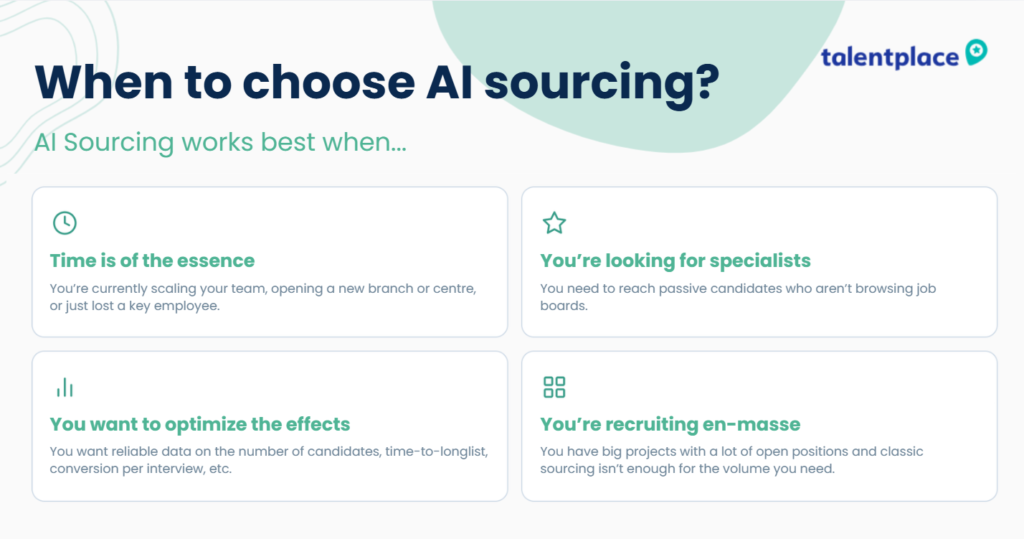
Buying an AI sourcing tool may make sense if the organization has a team that regularly runs sourcing, tests tools, works with data, and has time to build an internal process.
An AI sourcing service may be more practical when the company lacks time, struggles to reach candidates, has an urgent role to fill, or does not yet have a ready workflow.
In that case, the company does not need to learn everything from scratch. It can use a process in which technology, sourcing expertise, and recruiter experience are already connected.
This approach works especially well when the company does not need another system to manage, but a clear outcome: relevant candidates who are worth speaking to.
Final Thoughts: To AI Source or to Outsource AI Sourcing?
AI sourcing is one of the most practical ways to use artificial intelligence in recruitment.
With AI, HR teams can analyze more sources, build longlists faster, and prioritize candidate outreach more effectively. But the real value appears only when technology is combined with recruiter expertise and clear evaluation criteria.
That is why working with Talent Place can be a practical alternative to testing tools from scratch.
Our team helps analyze the role, map the market, identify relevant profiles, and verify candidates before they are passed further into the recruitment process.
For companies, this means less operational work for internal HR teams, faster access to candidates, and more confidence that sourcing will not end with a random list of profiles.
If you want to see how AI sourcing can support your recruitment process, talk to us.
FAQ
- How does AI sourcing work in recruitment?
AI sourcing analyzes data from different sources, compares candidate profiles with role requirements, and helps identify which people are worth contacting first. It works best when it is based on a strong sourcing brief, clear evaluation criteria, and a process in which recruiters verify AI-supported results.
- What is the difference between AI sourcing and traditional candidate sourcing?
Traditional sourcing relies mostly on manual candidate search, profile analysis, and message preparation. AI sourcing supports these activities with technology. It helps recruiters analyze more sources faster, compare candidates using consistent criteria, and prioritize profiles. The difference is not only speed, but also a more structured process.
- When should a company use AI sourcing?
AI sourcing is worth considering when a company is looking for rare profiles, recruiting for specialist roles, trying to reach passive candidates, preparing a longlist quickly, or running multiple similar recruitment processes at the same time. It is especially useful when speed, quality, and structured evaluation matter.
- Is AI sourcing safe in regard to recruitment quality?
AI sourcing can improve recruitment quality if it is based on clear criteria, recruiter control, and a measurable process. The risk appears when a company treats AI results as final decisions or relies only on keyword matching. AI should support analysis and prioritization, while the final evaluation of candidate fit should remain with a human.
- What do you need to implement AI sourcing well?
The foundation of effective AI sourcing is a good sourcing brief, clear must-have and nice-to-have criteria, candidate scoring, a defined list of sources, hiring manager calibration, and quality control rules. An AI tool alone is not enough if the company does not know how to evaluate candidate fit.
- Is it better to buy an AI sourcing tool or use an AI sourcing service?
It depends on the company’s internal resources. Buying a tool may make sense if the organization has a mature talent acquisition team, time to implement a process, and people who will regularly work with data. An AI sourcing service may be better when the company needs a faster outcome: a qualified longlist, candidates for interviews, or support in a difficult recruitment process without building everything internally.
- Can Talent Place provide sourcing without running the full recruitment process?
Yes. Talent Place offers two cooperation models: AI Sourcing + Longlist, where the client receives a selected longlist and manages the next stages independently, and AI Sourcing + End-to-End Recruitment, where Talent Place supports the entire process and delivers candidates ready for interviews.