When an HR team budgets for a sales hire, they usually think about one number: the salary on the offer letter. Almost nobody budgets for the cost of the search itself, the cost of the vacancy, the cost of getting it wrong, or the cost of lost revenue while the seat sits empty. And those are exactly the line items that decide whether hiring a salesperson actually pays off.
Below, we break down what the true cost of hiring a salesperson looks like in Poland in 2026 — from base salary bands, to typical agency fees, to the hidden costs most companies never see coming until they’ve already paid for them.
What Salespeople Earn in Poland in 2026
Sales pay varies enormously by seniority, industry, and how commission is structured. The table below shows typical base salary ranges (before commission) for the roles companies hire most often for their sales teams.
| Role | Monthly Gross Base Salary |
|---|---|
| SDR / BDR (lead generation) | 8,000–12,000 PLN |
| Account Executive / B2B closer | 9,000–14,000 PLN |
| Key Account Manager | 8,600–15,700 PLN (median ~11,750 PLN) |
| Sales Manager | 15,000–22,000 PLN |
| Head of Sales / Sales Director | 21,000–36,000 PLN (median ~20,900 PLN) |
On top of base, most of these roles carry commission worth another 10–40% of base, which meaningfully raises total cost of employment — and, in turn, the recruiting fee calculated against it.
What the Search Itself Costs
Most Polish recruiting agencies work on a success-fee model, charging a percentage of the candidate’s annual gross salary. For sales roles, typical rates look like this:
| Role | Typical Success Fee | Example Cost |
|---|---|---|
| SDR / BDR | 15–18% | 14,000–26,000 PLN |
| Account Executive | 15–20% | 16,000–34,000 PLN |
| Key Account Manager | 18–22% | 19,000–41,000 PLN |
| Sales Manager | 20–25% | 36,000–66,000 PLN |
| Head of Sales / Sales Director | 25–30% | 63,000–130,000 PLN |
And that’s still just the agency invoice. The real cost of the process runs higher — which is where it’s worth doing the math before the recruiting budget gets signed off.
A Simple Formula for the Real Cost of a Sales Hire
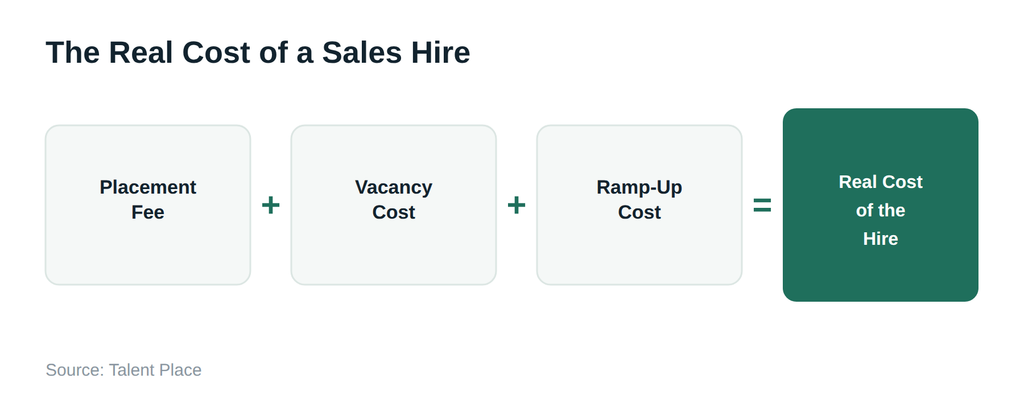
To get to the full cost, add three things on top of the placement fee:
1. The cost of the vacancy. Every month a sales seat sits empty, the company isn’t just skipping a paycheck — it’s losing potential revenue. If a rep typically closes 40,000 PLN a month in new business, a three-month vacancy isn’t a rounding error. It’s a real, measurable loss.
2. The cost of ramp-up. Manager and team time spent on onboarding, product training, and getting a new hire up to speed in the CRM and sales process — typically 4 to 8 weeks, during which the new rep generates little to no revenue.
3. The cost of a bad hire. If the person quits or gets let go within the first six months, every cost above resets to zero — plus you lose whatever client relationships they’d started to build.
The simplified formula looks like this:
Real cost of the hire = placement fee + (monthly vacancy cost × months to fill) + ramp-up cost
For a Sales Manager role at 18,000 PLN base, a 22% fee (~47,500 PLN), and a two-month search, the placement fee is only the starting point — adding in vacancy cost and ramp-up time typically raises the total cost by another 30–50%.
Why a Bad Sales Hire Costs More Than a Bad Hire Anywhere Else
Sales is one of the roles where a bad hiring decision shows up fastest — and hits hardest — in the numbers. An underperforming rep isn’t just a missed quota. It’s also:
- clients who were engaged and then lost,
- the sales manager’s time spent correcting instead of coaching the rest of the team,
- a delayed number for the whole team’s plan, not just one person’s.
That’s why the variable that actually lowers total cost on a sales search isn’t the lowest possible fee — it’s getting the fit right the first time. We’ve seen the same pattern play out across dozens of sales searches at Talent Place: the strongest results come from placement quality, not from chasing the lowest headline fee.
How to Lower the Cost of a Sales Hire Without Cutting Corners
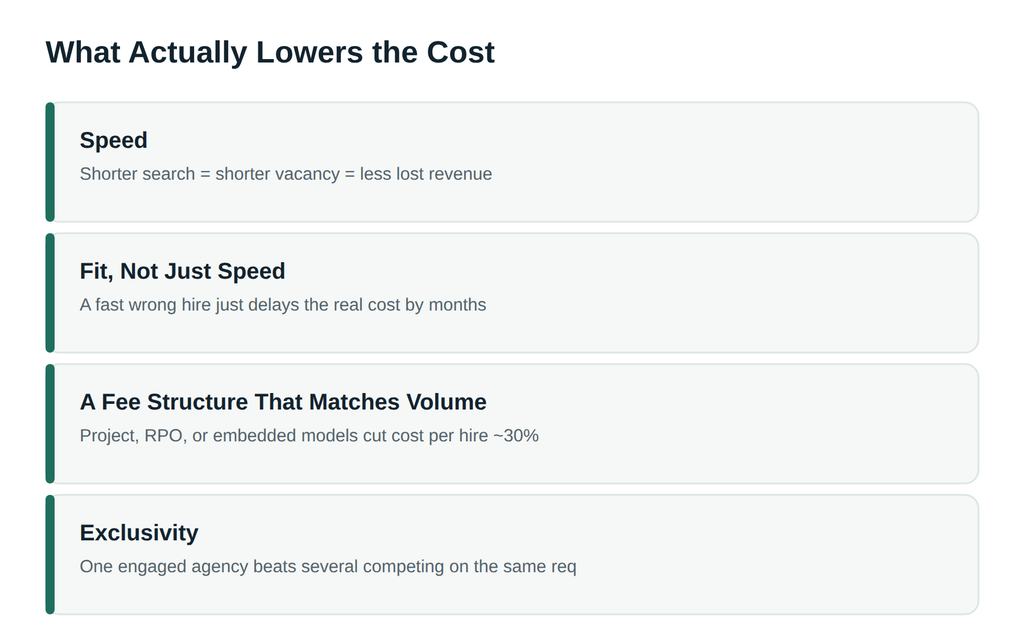
A handful of factors genuinely move the total cost of the process:
Speed. The shorter the search, the shorter the vacancy, and the lower the cost of lost revenue. At Talent Place, our average project turnaround is about 3 weeks, powered by a network of 400+ recruiters working candidate sourcing in parallel.
Fit, not just speed. A fast hire who isn’t the right fit just pushes the cost down the road a few months. It’s worth asking an agency not just about time-to-fill, but about their actual success rate and fee structure — ours runs around 95% of projects ending in a successful placement.
A fee structure that matches your hiring volume. A one-off success-fee search makes sense for a single hire. If you’re running several sales searches a year, a project-based model, RPO, or renting a dedicated recruiter can cut the cost per hire by as much as 30% — because it removes the fixed overhead baked into every individual search.
Exclusivity instead of running multiple agencies at once. When several agencies compete for the same req in parallel, each one prices in the risk of losing the placement — which pushes fees up. Exclusivity typically means a lower rate and a more engaged search.
The Bottom Line
The cost of hiring a salesperson is more than the number on the agency invoice. It’s the sum of the placement fee, the vacancy cost, the ramp-up cost, and the risk of getting it wrong. Count only the first line item, and it’s easy to conclude that agency recruiting is too expensive. Count all four, and a well-run search is often cheaper than a DIY hire that doesn’t work out.
Want to find out what it would actually cost to fill a specific sales role at your company? Book a free consultation — we’ll price out the project and show you how much time and budget you could save through our network of 400+ recruiters and a model that isn’t built around placement fees alone.