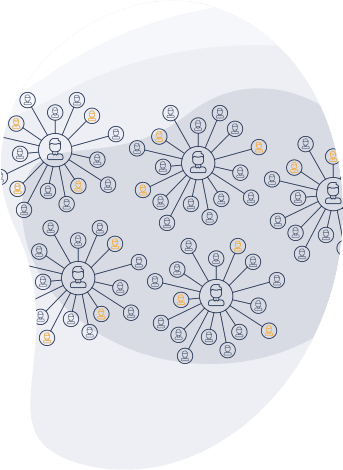
A network of expert recruiters, each with their own candidate database, working simultaneously on your open roles. No job board waiting, no single-recruiter bottleneck, just fast, precise, community-powered hiring.
That’s crowdstaffing, an operating model for better, broader, and more flexible recruitment.
What is Crowdstaffing? Definition and Core Concept
Crowdstaffing is a recruitment model in which a company gains access to a coordinated network of specialized recruiters instead of relying on one internal recruiter or one agency consultant.
Each recruiter brings their own market knowledge, candidate relationships and sourcing channels, while the process is managed under one shared standard—the client still works within one process, but the search is powered by many networks at once.
The underlying logic is simple: the more expert perspectives you apply to a search, the faster and more accurately you find the right candidate.
Like crowdsourcing or crowdfunding, it is built on the idea that a connected group can achieve something faster and more effectively than one person working alone.
| Crowdstaffing vs crowdsourcing Crowdstaffing is sometimes confused with crowdsourcing, but the two terms are not identical. Crowdsourcing usually means opening a task to a broad group of people. In recruitment, this could mean collecting referrals, CVs or candidate suggestions from many contributors. Crowdstaffing should be more structured. Recruiters are selected for the project, the process is coordinated, and candidates are screened before recommendation. The employer does not have to manage dozens of disconnected contributors or evaluate every CV from scratch. |
Key Benefits of Crowdstaffing
Faster delivery
The biggest benefit of crowdstaffing is that it significantly shortens the route to the first qualified candidates.
When more than one qualified recruiter works on a role, sourcing can happen in parallel instead of one recruiter moving through the market alone. They can activate existing candidate relationships, referral networks and warm databases from the start.
Access to passive candidates
Recruiters build relationships through years of industry networking, referrals and direct search activity. When these networks are combined, employers gain access to a broader, less obvious part of the candidate market.
In fact, the majority of talent that crowdstaffing reaches are so-called passive candidates, meaning they are not actively browsing job boards.
Multi-disciplinary coverage in one engagement
Most recruitment agencies specialize in one vertical. Crowdstaffing makes it possible to hire an IT architect, a financial controller, and a production supervisor under a single coordinated engagement, each handled by a recruiter who genuinely specializes in that segment.
Scalability without structural overhead
Internal HR teams often have limited capacity. When recruitment needs increase suddenly, companies usually have two options: overload the internal team or hire additional recruiters.
Crowdstaffing creates a third option. The company can increase recruitment capacity for a specific project without permanently expanding the internal HR department.
Read also: Internal recruitment – pros and cons – Recruitment Agency Talent Place
Candidate experience and quality control
Each recruiter in the network acts as an interview partner for every candidate they present, regardless of that candidate’s seniority. This means candidates receive a meaningful, professional interaction, which matters for employer brand perception. Clients receive only pre-screened recommendations with detailed profiles, not raw CVs.
Crowdstaffing vs Traditional Recruitment: Side-by-side Comparison
| Area | Traditional recruitment | Crowdstaffing |
| Recruiter capacity | Usually one recruiter or small team | Distributed network of recruiters |
| Candidate access | Limited to a single database and sourcing channels | Wider network of candidate relationships |
| Speed | Usually sequential | Parallel sourcing |
| Scalability | Limited by capacity | Easier to scale across roles and markets |
| Best for | Standard or retained searches | Fast, specialist, multi-role or multi-market hiring |
How Does Crowdstaffing Work?
Crowdstaffing is not about sending one vacancy to a random group of people and waiting for CVs.
A strong crowdstaffing model needs coordination, recruiter selection, candidate screening and clear ownership of the recruitment process.
A typical process looks like this:
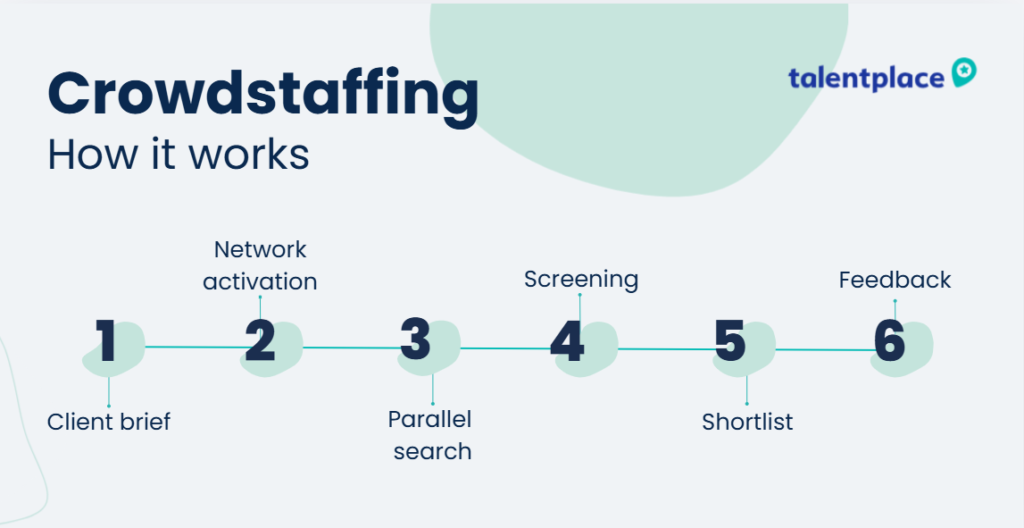
- Briefing and role definition
The process starts with a recruitment brief. The employer defines the role, required skills, location, seniority level, salary range, hiring timeline and must-have criteria.
A central coordinator (at Talent Place, this is your dedicated project manager) translates this into a structured brief distributed to the network.
Before recruiters begin sourcing, the recruitment partner should check whether the role is realistic in the current market. This may include salary benchmarking, talent availability, competition analysis and possible risks.
- Network activation
In crowdstaffing, not every recruiter works on every role. The strength of the model comes from matching the project with recruiters who understand the relevant industry, candidate profile and market.
A recruiter experienced in IT hiring will usually approach the process differently than someone focused on finance, engineering, sales or customer service. That specialization matters, especially when candidates are passive and need a more precise, credible approach.
- Parallel direct search and database mining
This is where crowdstaffing differs from traditional recruitment. Once the project starts, multiple recruiters work in parallel, each using their own sourcing channels, candidate databases and contact networks.
The community can also cross-reference leads internally: if a candidate known to one recruiter matches another recruiter’s project, the recommendation can be shared within the network. As a result, the employer benefits from broader candidate reach and faster access to relevant profiles.
- Screening
Before any candidate is presented to the client, the recruiter conducts a screening interview and prepares a detailed recommendation note covering the candidate’s experience, motivations, and fit for the specific role. The goal is to deliver relevant, pre-screened candidates who match the agreed criteria.
- Shortlist review
The client receives selected candidates who meet the project requirements—the standard is three strong recommendations per position. Feedback is then used to refine sourcing and improve the quality of further recommendations.
This feedback loop is important. It allows the recruitment team to adjust quickly if the market response is different than expected or if the company changes its priorities during the process.
How Different Companies Can Benefit From Crowdstaffing
Crowdstaffing is useful for companies at different stages of growth, but the reason for using it often depends on the size and structure of the organization.
Enterprises and multinationals
For enterprises, crowdstaffing is useful when recruitment is blocked by volume, complexity or market coverage. This may include high-volume hiring campaigns, expansion into new markets, recruitment across several business units or temporary support for internal Talent Acquisition teams during peak demand.
The main advantage is the ability to scale recruitment capacity quickly while keeping the process coordinated.
Mid-size companies
Mid-size companies usually use crowdstaffing when internal HR is stretched. This often happens when several departments are hiring at once or when a niche role falls outside the team’s usual sourcing experience.
It’s a way to add specialist recruitment capacity without forcing the company to change its internal HR structure.
Startups & scale-ups
Startups and scale-ups often need to hire quickly before they have a mature in-house recruitment function. Crowdstaffing gives them access to experienced recruiters and candidate networks without requiring them to build full HR infrastructure too early.
Smaller companies
For smaller companies, the challenge is often not hiring volume, but access. Instead of depending only on job ads or the founder’s personal network, the company can use crowdstaffing to reach candidates through recruiters who already know the market, understand where to look and can present the role in a credible way.
When Crowdstaffing Is NOT the Right Choice
No recruitment model is universal. Crowdstaffing tends to be a less optimal fit in the following scenarios:
- Highly confidential executive searches where discretion requires a tightly controlled, relationship-driven approach with a named search partner. In these cases, a dedicated executive search engagement is more appropriate.
- Employer branding-first initiatives where the primary goal is building long-term perception in a specific local market, rather than closing roles quickly.
- A single, non-urgent hire with no particular time pressure and a well-defined local talent pool. A simpler project-model or direct posting may suffice.
- Roles requiring deep, single-specialist immersion — such as unique research positions where one recruiter spending weeks in a narrow community will outperform parallel surface-level searches.
How Talent Place Uses Crowdstaffing
Good recruiters know where to find candidates, how to approach them, and how to assess whether the opportunity makes sense for them. Crowdstaffing creates a model where this knowledge has direct value. Recruiters can support projects that match their expertise, use their own candidate relationships, and work within a coordinated recruitment process instead of operating alone. The client still receives structured recommendations, but the search benefits from recruiters who are closer to the candidate market.
At Talent Place we combine crowdstaffing with talent pooling, direct search, and referral systems. Thanks to this, we can reach candidates who are not actively applying and provide employers with selected recommendations faster than in many traditional recruitment models.
Depending on the client’s needs, this can support project recruitment, RPO, IT contracting, industry-specific recruitment, or international hiring.
The employer does not have to choose the model alone; our first step is always to understand the hiring goal: how many people need to be hired, how quickly, in which market and with what level of specialization. Then our recruiters bring their own market knowledge, candidate relationships, and sourcing channels. Talent Place coordinates the process, while the recruiter community broadens the reach of the search.
This approach allows us to connect employers with candidates faster, gives clients access to more options and possibilities, and makes recruitment more flexible than in a traditional model.
Ready to see what community recruiting can do for your team?
Tell us about your open roles and we’ll show you how Talent Place’s network of 400+ recruiters can close them faster.
Frequently Asked Questions About Crowdstaffing
- What is crowdstaffing in recruitment?
Crowdstaffing is a recruitment model based on a coordinated community of recruiters. It gives companies access to a wider network of recruiters, candidate databases, referrals and direct search channels.
- Why does Talent Place use crowdstaffing?
Talent Place uses crowdstaffing because it allows recruitment projects to be supported by recruiters with different specializations, networks and market knowledge. This helps reach candidates faster and scale recruitment capacity when needed.
- Is crowdstaffing the same as a traditional recruitment?
No. A traditional agency or recruitment process relies on its internal consultants. Crowdstaffing uses a wider recruiter community while keeping the recruitment process managed by one partner.
- Is crowdstaffing good for specialist recruitment?
Yes. Crowdstaffing can be effective in specialist recruitment because it allows the project to involve recruiters who understand specific industries, roles, and candidate markets.
- How quickly can crowdstaffing deliver the first candidate recommendations?
Because multiple recruiters work in parallel from existing candidate databases, the first pre-screened recommendations can typically be delivered within days of the project brief being confirmed, which is significantly faster than sequential search processes. Exact timelines depend on role complexity and seniority level, but Talent Place has first recommendations ready usually within 7 days.
- Can crowdstaffing handle hiring across multiple countries at the same time?
Yes, this is actually one of its strongest use cases. A coordinated recruiter network can activate sourcing simultaneously in multiple markets, with each recruiter operating in their local talent environment. This eliminates the need to establish local HR structures before hiring begins, making it particularly well-suited for international market expansion.
- Is crowdstaffing suitable for small companies with limited hiring budgets?
Yes. Unlike RPO, which typically involves longer-term contracts and embedded teams, crowdstaffing can be commissioned on a project basis, meaning you engage the network only for the specific roles you need to fill. Small businesses and startups can benefit from the same quality and speed as larger organizations without committing to a long-term recruitment partnership.
- What industries can crowdstaffing cover?
At Talent Place, the recruiter community covers IT, sales, marketing, BPO/SSC, engineering, production, finance, and management roles, among others. Because each recruiter maintains their own specialized candidate pool, the network can simultaneously handle positions across multiple industries within the same engagement and without any one recruiter being a generalist.
- What is the difference between crowdstaffing and RPO?
Crowdstaffing increases access to a wider recruiter network and candidate pool. RPO gives the company dedicated recruitment support over a longer period, often as an extension of the internal HR team.
- When should a company use crowdstaffing?
A company should consider crowdstaffing when it needs faster candidate access, specialist recruitment support, passive candidate reach, or scalable hiring capacity without expanding the internal HR team