A company grows to 60, 100, 150 people, and leadership starts seeing the same problems surface: managers don’t know how to handle a difficult conversation, performance reviews are a formality nobody takes seriously, and good people leave without any warning. Someone needs to fix this — but it isn’t always clear whether that means hiring a permanent HR Business Partner.
A full-time HRBP hire is a serious commitment. At a median salary of 11,000 PLN gross per month (Talent Place, 2026), the employer’s cost alone runs past 159,000 PLN a year — before recruiting fees and the candidate’s own 1–3 month notice period. Renting an HRBP for a project lets you start within days and pay only for the hours you genuinely need.
In this article, we cover when renting pays off, when a permanent hire is the better call, how to actually work out the cost, and what the first 90 days of the engagement look like.
What “Renting an HRBP” Actually Means
A rented HRBP is an experienced HR Business Partner who works inside your company like a member of the team — but only for the time you need and only for the length of the project. They advise leadership, support your managers, and implement changes themselves, rather than handing over a report full of recommendations and walking away.
At Talent Place, this works in two forms (HRBP outsourcing):
- Project HRBP, billed by the hour — a few hours a week, or two days a week, for example.
- Full-time or part-time HRBP, with scope and responsibility defined entirely by you.
We present candidate profiles within 7 days of your request, and the engagement is overseen throughout by our own HRBP Manager.
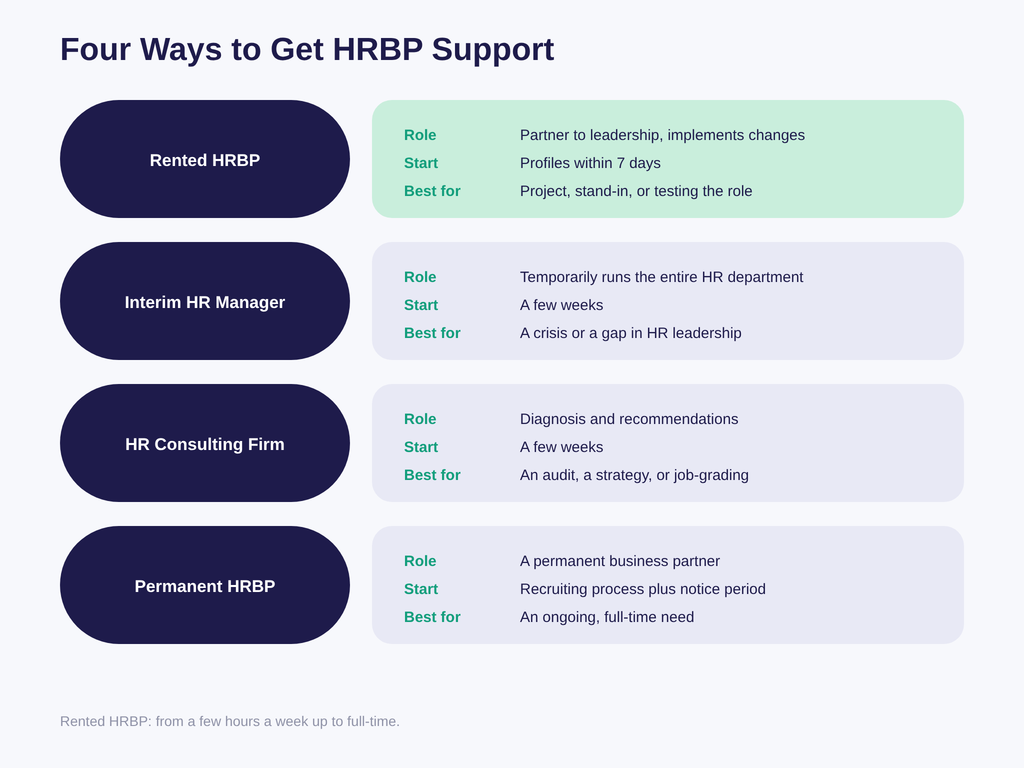
| Rented HRBP | Interim HR Manager | HR Consulting Firm | Permanent HRBP | |
|---|---|---|---|---|
| Role | Partner to leadership and managers, implements changes | Temporarily runs the entire HR department | Diagnosis and recommendations, often without implementation | A permanent business partner |
| Time commitment | From a few hours a week up to full-time | Usually full-time | A defined-scope project | Full-time |
| Time to start | Profiles within 7 days | A few weeks | A few weeks | Recruiting process plus notice period |
| Best for | A project, a stand-in, or testing the role | A crisis or a gap in HR leadership | An audit, a strategy, or job-grading | An ongoing, full-time need |
When Renting an HRBP Actually Pays Off
Renting makes sense when the need is urgent, time-bound, or when you simply don’t know yet whether the role should become permanent. The situations that come up most often:
A 50–150 person company with no HR department yet. The need for an HRBP typically shows up around the 100-person mark, but problems with managers and turnover usually arrive well before the budget for a full-time hire does.
A one-off project. A restructuring, merging teams, rolling out performance reviews, or sorting out your pay structure. That last one is especially urgent right now: as of December 24, 2025, employers in Poland must disclose salary or a pay range to candidates (source: Infor), and the EU Pay Transparency Directive requires consistent job grading to go with it.
Covering a gap. Parental leave, an HRBP leaving unexpectedly, or the time it takes to find a permanent successor. That’s exactly what Travelist.pl did — they had candidate profiles within a week, and the engagement stayed within the agreed budget.
Testing the role before committing to a hire. A few months working with a rented HRBP shows you exactly how many hours you actually need, and what kind of person to hire permanently. That’s how the Try&Hire model worked for Talkin’ Things, which brought its HRBP on permanently after a few months of collaboration.
Fast growth, or a new location. Opening a new office, when HR processes need to exist before a local team does.
Renting doesn’t pay off when:
- what you actually need is payroll and personnel administration, not a partner for leadership — in that case, payroll/HR outsourcing or an HR generalist is the better fit, which we cover in Payroll, HR Generalist, or HR Business Partner: Who Does Your HR Team Actually Need?
- you already know you need a full-time HRBP for years to come
- there’s no one in leadership who will actually sponsor the changes — without that person, even the best HRBP has no one to work with
What an HRBP Actually Costs: Permanent Hire vs. Rental
An hour of a rented HRBP costs more than an hour of a salaried one — but over a project lasting a few months, at partial capacity, the total usually comes out cheaper. The reason is simple: with a permanent hire, you’re paying for every month, every vacation day, and the recruiting process itself; with a rental, you pay only for hours actually worked.
| Permanent HRBP (median) | Senior Permanent HRBP | Rented HRBP | |
|---|---|---|---|
| Gross monthly salary | 11,000 PLN | ~16,000 PLN | N/A |
| Employer’s monthly cost (~20.5% contributions) | ~13,250 PLN | ~19,280 PLN | Rate × hours worked |
| Employer’s cost per year | ~159,000 PLN | ~231,000 PLN | Project hours only |
| Agency recruiting fee (15–25% of annual salary) | 19,800–33,000 PLN | 28,800–48,000 PLN | None — profiles within 7 days |
| Time to start | Process plus 1–3 month notice period | Process plus 1–3 month notice period | A few days to 2 weeks |
| Effective hourly cost | ~89 PLN | ~129 PLN | Rate as quoted |
Assumptions: median of 11,000 PLN per Talent Place (2026); senior figure per a 2024 survey of 645 HRBPs by the Polish Association of HR Practitioners (via Rzeczpospolita). Effective hourly cost is annual cost divided by roughly 1,790 working hours (about 2,000 working hours minus 26 vacation days). This excludes sick leave, benefits, and equipment, so the real cost of a permanent hire runs higher still.
An example. A 90-day project at two days a week comes to roughly 208 hours. Even at a rate twice the effective hourly cost of a permanent hire (about 178 PLN), that’s roughly 37,000 PLN total. Three months of a permanent hire costs roughly 39,800 PLN in employer costs alone, plus 19,800–33,000 PLN in recruiting fees — and once the project ends, you’re left holding a full-time role.
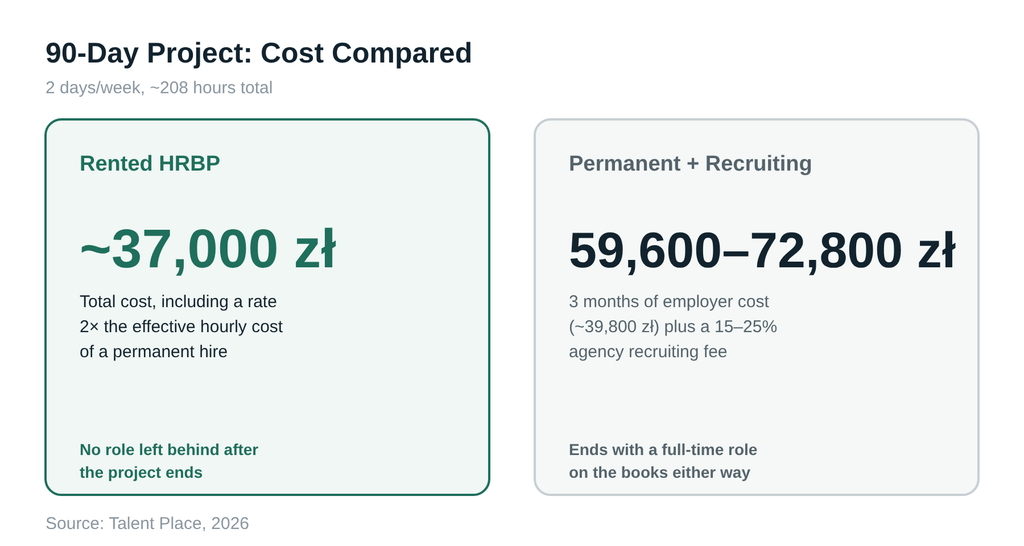
A simple rule of thumb: if you need an HRBP for less than half-time, or for less than a year, renting wins almost every time. Once the need grows into a genuine full-time, ongoing role, it’s worth calculating exactly when the switch to a permanent hire pays off. We make a similar comparison — contract versus permanent employment, for tech specialists this time — in 7 Situations Where Hiring Contractors Beats Full-Time Employees.
Getting Your Company Ready for Day One
The better prepared your first week is, the more of those 90 days go toward actual work instead of chasing down documents.
- [ ] One sponsor in leadership who can make decisions and has time for a weekly check-in
- [ ] The project’s goal stated in a single sentence, plus 2–3 measurable outcomes for the end of the 90 days
- [ ] An agreed hours budget and time commitment — two days a week, for example
- [ ] A list of the managers the HRBP will work with, briefed in advance on who this person is and why they’re there
- [ ] Access to the org chart, workplace and pay policies, job descriptions, and turnover data
- [ ] An NDA and a data-processing agreement in place, since the HRBP will be working with employee data
- [ ] A review date set at 30 and at 90 days
The First 90 Days, at a Glance
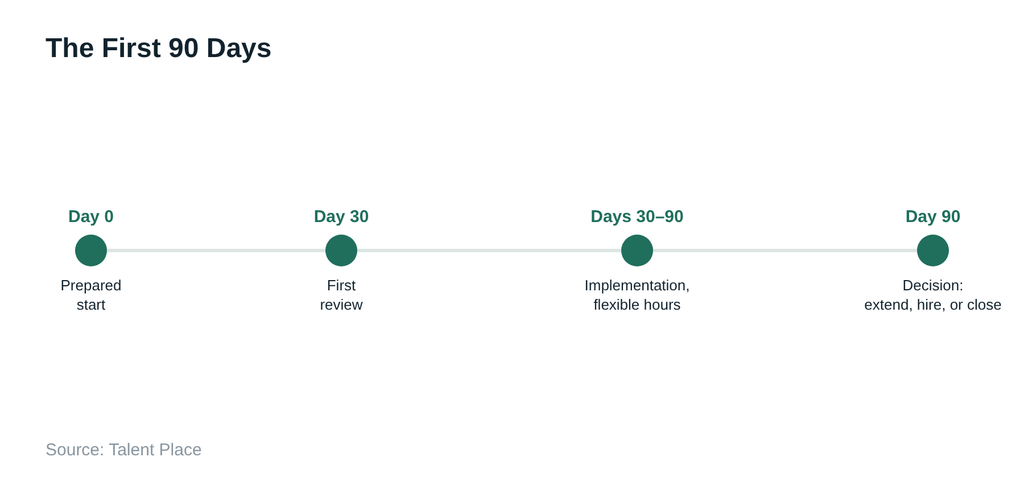
The sequence follows directly from the checklist above: a prepared start, a review at day 30, a flexible hours commitment through implementation, and a decision at the end of day 90.
Frequently Asked Questions
How many hours a week does a rented HRBP actually work?
As many as the project calls for — anywhere from a few hours a week to full-time. The commitment can flex during the engagement: more hours during implementation, fewer during handover.
Can a rented HRBP later move to a permanent role?
Yes. You can start with a project and, once the role proves itself, move to a part-time or full-time HRBP arrangement — or hire someone permanently with our recruiting support.
Who’s accountable for the quality of the HRBP’s work?
The engagement is overseen throughout by Talent Place’s own HRBP Manager. If the person isn’t the right fit for your company, we find a replacement.
How is confidentiality handled?
An HRBP works with employee data, so before the engagement starts, you sign an NDA and a data-processing agreement in line with GDPR.
Need an HRBP for a project? At Talent Place, you get access to a community of more than 400 HR and recruitment experts. Tell us about your project, and within 7 days we’ll present HRBP profiles matched to your industry and company size. See how HRBP outsourcing works, and let’s set up a call.